How Do You Use Study Resources

screenshot of Olive Tree Bible Study App when using concordance resources
The other day while going through email, I noticed a newsletter from the good folks over at Olive Tree Bible Software. As I read, I saw a neat piece in there about how to use a concordance with their software. Here’s a snippet:

…As you can see, the Olive Tree Concordances are much more than a list of cross references for each word in the Bible. With dictionary information tied to the original language, these resources are valuable tools for Bible study. Each concordance comes with a copy of the Bible in the selected translation…

Read the rest of Using A Concordance in the Bible Study App at the Olive Tree Blog

That piece got me thinking back to how I used to use print resources, then print and web, and then later web and mobile resources in order to do my studies. A good deal of the work that went into feature suggestions and the design of Palm Bible+ app which accelerated my travels in this space. It was very important then to not just have access to the resource, but have it in such a way that it didn’t interrupt the reading flow, but was there when needed. Now then, we did things with the PalmOS Graffiti system, and even the keyboard on Treo devices to make that happen. These days with touch and more consistent connectivity, designing these resources into an app is a bigger challenge.

Even with that challenge, its still a suitable flow of use. So, let’s open question that titles this post (how do you use study resources) with a few qualifiers:

  • For those of you who might use commentaries, concordances, etc. in your private reading, how do you do it? What could be done better?
  • For those of you who use those resources while teaching, what kinds of challenges do you run into either from the side of teaching or the side of sharing the sources of that info with students?
  • For those wh might use these resources to teach, but don’t share them with your students/audiences, why?

There you have a few ways to frame an answer. Let’s hear what you have to say towards using study resources, especially with your mobile-enabled audiences.

Adaptive Interfaces

All Books on Nokia N8 screenshot

Many of the user interfaces that I come across on the various mobile devices that I interact with are not all that neat. Let me correct that. They were novel and neat when I first acquired the device or application. But, that quikcly got old and stale – especially in those applications that I interacted with the most. What would be neat in many of those cases is the interface adapting to my increased usage and then changing to either expose more of itself, or trimming to only exposing the features that I use the most.

I’ve taken to calling it adaptive intelligence or an adaptive interface. Basically that as I spend time in the application or program, that it adapts to my greater comfort with some features, and recommends or trims what I see based on what is learned about my usage. This was some of what when into my UI design for All Books – as you went into a book/chapter, the book name/chapter number would “age,” dimming itself compared to what you haven’t read as much. In time, you could see what areas of the Bible it was that you didn’t read much easier than you could get to the parts you did read more often.

I’m not the only one thinking along these lines, but I do think that its something that we can do a good bit more of in this space of faith-based content. It seems like a new UI idea, and even has been proposed as much in an article at FastCo Design:

…In 1975, the Hungarian psychology professor Mihaly Csikszentmihalyi outlined his theory of “flow” in his seminal work, Flow: The Psychology of Optimal Experience. He defined the concept as ‘‘the holistic experience that people feel when they act with total involvement.’’ When in the flow state, people become absorbed in their activity, narrowing their awareness to the activity itself, losing self-consciousness, and feeling in control of their environment. Flow is also proven to have a positive impact on learning. In skiing, novice practitioners are advised to spend the first few days at the green beginner slopes to get the best learning experience. On the other hand, experienced skiers will find themselves bored at the beginner slopes and must seek their optimal experience on the black expert slopes. This individual balance between skill and challenge is, according to Csikszentmihalyi, called the “flow zone” and staying in this flow zone is the best possible way to learn and make progress while still feeling constantly challenged and intrinsically motivated.

While flow has been extensively applied in studying a broad range of contexts, such as sports, shopping, rock climbing, dancing and others, I believe that, by drawing inspiration from video games, flow can be used to improve the user experience in interactive electronic consumer products…

It takes a lot of foresight to make an interface like this. Similar to the classic “choose your own adventure” books, the application author has to be content with designing many paths to a solution, and doing so in a way that doesn’t break up the story. What would a bible look like if it adapted to our reading tendencies? Or better, what about a Bible app that started off doing simple search and reading, then evolved to something like a full-blown study/sermon companion like Logos/Olive Tree’s products? Would be kind of neat IMO.

MobMin.Info Updates

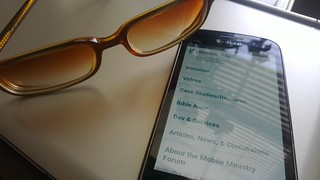
MobMin.Info screenshot

Some time back, we announced the MobMin.Info portal – a simple resource portal to much of what’s happening within this space we call mobile ministry. Since its unveiling, there have been a few updates to it, and we want to highlight those items, as well as the updates that have happened most recently:

  • The addition of a Videos section – pointing to several videos which speak directly to mobile ministry (definition, activities, and trends)
  • The addition and refinement to the Bible Apps and Dev & Services sections for more platform-specific content – so if you are trying to build or deploy something, this is a one-stop-shop for those resource links
  • An updating to the Articles, News & Discussions sections links – adding a bit more of what’s happening in social networking spaces (if anyone has a mobile ministry specific link for Facebook, please send that and we’ll get that there too
  • Setting up the page to act like a mobile app – so that you can access this when offline, and if needed, you can utilize your mobile device’s ability to send links to others (via SMS, Email, or Bluetooth) for those items which might be applicable to them; this feature uses the HTML 5 Application Cache feature, and has been implemented as a beta/experiment play (this might not work on your device)

Hopefully, this is something that can serve to help you better understand what mobile ministry is about. And if you are looking to develop, this kind of page can potentially serve as a template to guide you towards how to translate content into a mobile-friendly view (for example, this portal page uses elements from Modernizr, jQuery, and Google Analytics in concert with a UI custom design).

If you have any additional items that should be added here, please get in contact with us so that we can update accordingly. To view this portal, simply point your browser to http://mobmin.info

Faith’s Interface

The Brick (lego) Testament - Exodus and the 10 Commandments
Another one of the reasons why the All Books Project has been beneficial is in the discussion about interfaces to faith. Specifically, how the tools we use within our faith – these can be sacraments, behaviors, doctrines, as well as computational helps – give us an approach to our faith which may or may not be something that can resonate with others. Where we might esteem one method or another, or one tool or another, but that doesn’t mean its the last answer on the topic. What’s interesting though is how the idea of interface begins to play out within the space of having and manipulating content on the screens and keyboards of our mobile devices. If these devices and their content are viable, then we should see them actively drawing one another closer to God. If not, then they are an interface that causes the wrong kind of friction… one that should probably be removed.

Over at the website The Cooper Journal, there was the reignition of the discussion about interfaces and how when interfaces into actions or events are not well thought out, we end up with expereinces that degrade the impressions that we were to get from them. I liked the quote that was near the beginning of this, because when it comes to mobile ministry (#mobmin), I think we sometimes lose sight of this in the midst of making sure that we are mobile and are doing/performing/proving ministry:

As Donald Norman said in 1990, “The real problem with the interface is that it is an interface. Interfaces get in the way. I don’t want to focus my energies on an interface. I want to focus on the job… I don’t want to think of myself as using a computer, I want to think of myself as doing my job.”

When I think about the effect of this tech as a tool and enabler of the faith, I honestly start from this end. I don’t want to think of my faith as “ooh, I have a Bible app, now I can engage God as I should in this age.” I am learning and beginning to feel that if the faith doesn’t make Emmanuel (“God with us” – Matthew 1:23, Isaiah 7:14) more palatable to living, then its probably something that’s getting in the way of faith developing as it should.

For faith’s interface, I’m constantly reminded that the Israelites had a chance to have the simpliest of interfaces with God, but then chose to have Moses speak and entreat God on their behalf (Exodus 20:19). They chose a system of building a relationship with God where there was an additional 50 chapters of legal documents needed. A system that all parties agreed was flawed, but that one party only wanted to get rid of (God, who does this through Jesus’s death and resurrection).

I restate Norman’s quote, I don’t want to focus my energies on keeping devices charged, keeping content updated, worrying about where my email address might be going or be sold to. I want to focus on living a life that looks like it was gifted from Jesus Himself. I don’t want to think of myself as using this tool or service as my faith, I only want to be in the posture and position (Colossians 3:1-4) of living such that it looks like Him (Matthew 5:14-16).

I don’t believe that the work that’s done to build these computer tech tools and services for minsitry are evil. I don’t think they are the measure of our faith’s maturity either. I’m drawing close to God because of and in spite of these tools. We had a similar discussion in the past about sacraments – if they increase the tension that we have at making and keeping a relationship with God, then they are of no good use. But, if they bear witness of our maturing into the fact that God is with us, then let us use them to His glory and not our own; loving and esteeming one another… spurring one another unto all good works.

All Books Project Update

At the end of 2011, we started a project called All Books as an exercise in developing a Bible reader interface that was based around a spatial oriented UI than the normal list/task UI scheme. As the year has progressed, development has as well. There’s been some healthy learning about the limitations of using the Nokia Web Browser on my N8 as the baseline for this. Some lessons towards JavaScript and what works efficiently and what doesn’t. And a few more lessons here and there.

At the end of last month, I got around a Windows PC and was able to send to GitHub the updates that have been pending for the All Books Project (as of right now, I’ve not seen a solid GitHub app for the iPad that works with the web developer app Textastic; open to recommendations). So, if you aren’t watching that repo, I would recommend that you take a look at All Books on GitHub and download the update. Here’s the summary of the updates

UI Updates:

  • added HTML5 local storage for usage stats (needs fixing)
  • fixed a number of books which had incorrect URL pointers
  • fixed issue with navigation where stats wouldn’t hide
  • fixed issue with navigation where clicking on All Books from OT hid OT books instead of keeping them seen
  • shortened text on Reset Stats button

CSS Updates:

  • added CSS for stats area
  • added text-ellipsis for buttons

Now, remember, All Books is just a web-based interactive container (HTML5, jQuery for JavaScript, and CSS3). The content that I am feeding to this comes from Bible.org and several other sources (noted in the UI About section). You can pretty much take any directory of HTML documents that are Biblical in content and point this UI to. No, its not as clean as Browser Bible, YouVersion, OliveTree, and the others. This is in part by design. In order to know what works and what doesn’t you’ve got to sometimes get into things and build it yourself.

That said, All Books is also designed to be a gift to the folks at Bible.org. They have an excellent HTML package of the NET (New English Translation) Bible, but the HTML interface for it wasn’t the easiest to use on tablet and mobile devices. All Books answers that interface question, and sets the ground for the kind of interface that (when scripted) can easily translate across languages and levels of literacy. So to that end, I hope the Bible.org folks can appreciate these and keep pushing the Gospel forward.

If you have comments towards All Books, or would like to contribute to the project, visit the All Books Project on GitHub and just jump right on in. As for me, there’s an upcoming update to my Nokia N8 which might help performance issues, and finally get me on ball to some of the next features for this.

Identifying Non-Textual Mobile Language Opportunities

Gorillas talking using baby-talk, via National Geographic
Over the years, we have seen the acclimation of gestures and emotion-based icons as part of the vernacular of mobile communications. For those with some Nokia and Android phones, gestures such as flipping the mobile over to ignore a call or silence an alarm, have become normal – while still denoting a sense of the magic of what these bricks of sensors and antennas can do. For Many who are into their 2nd and 3rd touch-centric devices, pinching, swyping, and rhythmic tapping have led to interacting not just with the content on a linear level, but also has allowed for some psychological attachment to the content on devices. All of these are great, and in fact, becoming more core to the experience of not just mobility, but computing as a whole. An enduring lesson though should be derived from this:

Technology is part of the Biblical Story. It transforms the world and us.// Mediums communicate meaning & shapes thinking. #bioladigital (@neverarriving)

Now, while that was something stated on Twitter, and could at one point be thrown aside as a “sure, that makes sense” kind of comment. When we look at some of the research and observation towards language and learning beyond computing, we can begin to see that there’s a bit more at play with gestures and non-verbal communications which begs the question about not just our interplay with devices, but how these non-verbal behaviors can improve our relation to one another, or even our fatih experiences.

Take for example this observation of gorillas from a recent article at National Geographic:

In 2011, Luef and co-author Katja Liebal recorded video of lowland gorillas in two zoos: Zoo Leipzig in Germany and Howletts Wild Animal Park in the United Kingdom.

The team observed 24 gorillas, which they separated into four age groups: infants, juveniles, subadults, and adults.

The scientists focused on the animals’ behavior during play bouts, which are started and ended via nonvocal communication-an exchange of signals involving the head, limbs, and body posture used to manipulate another gorilla’s behavior.

Analyzing the video footage, the scientists then noted each gorilla’s nonvocal signals.

The team saw that gorillas in the three older groups touched infants more, which may be because the youngsters themselves communicate with their mothers via touch, Luef said.

It could be easy to dismiss this as something just needed for language and cultural studies, but I think that there are lessons here also for the mobile-tuned fatih communities in which we live. For example, when we see someone fondoling their mobile while in a conversation with another, or while in the midst of a group discussion – what kinds of messages are transmitted? Or, when you see a group of people at a concert or group event all throw up their mobiles as if they were flash lights and cigarette lighters – what kinds of experiences are they sharing with one another that might only be remembered again from a photo or video of the moment, versus a telling of it (“it was amazing, you just had to be there”).

Don’t get me wrong, I think there’s a place for text-based communication methods. As is there a place for pictorial (still and moving) and audio based comms. But, I do wonder if we aren’t also looking at some of the other ways in which we communicate, learn, and adapt ourselves to one another and our environments that are much more non-verbal. We’ve talked about in a previous article how even the keyboard can be augmented with a picture-based system that allows it to better target non-literate and multi-linugal contexts. There’s definitely an opportunity here.

I’ve seen with just the adaption of gestures on mobiles that there are ways in which we want to interact with data and one another that just aren’t as able to be captured with text and buttons. There’s room for more, but can the greater faith community break out of its diacletic/rhetoical leanings enough to see fatih practices that are augmented with computing look a bit different?

Mobile Industry Review and the Emporia Telecom Series

For a number of weeks now, Mobile Industry Review has been doing a series with Emporia Telecom, a company whose mobile offerings are designed around the needs of those persons who might be older or have needs for simpler and easier to undestand mobile devices. I hesitate to pigeon-hole their offerings into something just for an older audience, because everyone can do with better designed user interfaces, attention to detail/behavior, and such. But, their focus on this group is notable, specifically because it seems to follow along the lines of what we were getting at with our 4th resolution, intentional design decisions and UIs/UXs which follow mobile perspectives.

The Mobile Industry Review series has about six videos (at the time of writing) already published. I’d encourage you to take a look at them:

While watching these videos, or after watching them, consider these points in view of what you are planning or doing in respect to mobile ministry:

  • Does your application or service not just include smartphone and non-smartphone users, but the various ranges of age groups within each?
  • How does your application or service scale to age groups where information is consumed and retained in a different bucket than a UI guide’s recommended “lines per screen?”
  • How do you track or model healthier communication behaviors across age/demographic groups?

A step perhaps towards addressing that resolution by seeing the wisdom of designing for those who carry the most wisdom in many of our communities.

Spatial Interfaces, Theological Literacy

Tim Challies Visual Theology - Books of the Bible iPad-sizedLast week, or so, I wrote over on my personal site (Blog.AntoineRJWright) a post talking about this idea of spatial interfaces and how the concept of such a means of navigation intersects directly with the thoughts I’ve been having about theological (more specifically, biblical) literacy and what that means we should be enabling given this age of connectivity, productivty, and access to tools of publishing (re: internet). Here’s a snippet:

As I was just going through Twitter and seeing what all people have been posting about today. I came across a neat Biblical visualization from Tim Challies. Seeing this reminded me that I’ve not done much of an update here (or MMM) about the All Books Project that I’ve been working on. So, let’s talk spatial interfaces (a topic seen in a recent meetup I attended) and theological literacy – and why these merge nicely.

Read of the rest of Spatial Interfaces, Theological Literacy at Blog.AntoineRJWright

I make some bold claims in that piece (“theological literacy isn’t just reading/comprehension, but its able to (re)create the Word contextually” for example). What are your thoughts? Especially for those of you whom are teachers/pastors, can you teach to this level? And if not, are you misapplying the term literacy in light of the command in Matthew 28:18-20?

[Experiment] Redesigning MMM

[Screenshot] MMM Alternate Homepage - Share on OviFor a number of years now, we’ve been talking about redesigning MMM. This has been a much harder process than I would have thought because of changes in the general organization of site assets, as well as other tasks relating to making a living out of this endeavor. That said, things have been happening on that front and I’m ready to put forward something of a beta to what would/could be a new iteration of MMM.

View the Alternate/Redesigned MMM (for those viewing this on their mobile device, see the note at the bottom of this posting for an additional step to see this)

This is following inline with some of the 2012 resolutions we’ve posted so far (practicing what we preach). This is also an evolution in the philosophy behind MMM in being more than simply a destination towards information, but a collection of those stories presented in a way that accents the use of mobile towards addressing those questions and implications of using mobile in faith-based contexts.

Goals of the Redesign
Of the comments most heard about MMM, one of the loudest has been in the findability of information on the site. Indeed, its an issue. This site has been in existence since 2005 and there’s over 3000 posts full of content. In addition to just having those posts, there’s been several themes that have run throughout the site, making it harder still to simply use a search box to figure a direction to find things. This design seeks to make the entry point to the content better (behind the scenes, content is literally being reorganized to fit a consistent paradigm).

The other goal of this redesign is to reflect the overall user experience (UX) goal we’d have for mobile applications. There are a few mobile applications that we’ve published to date, yet none of them were able to capture exactly the kind of reading, searching, and interactive experience that we’vev been after. After careful consideration of the options (using one or more content management services, developing several native applications, etc.), it was decided that to create a single webpage that had most of the features in a mobile-first role would be the direction. This would be incomplete without redoing the entire WordPress template, so this initial design was completed in order to test the feasability of moving forward.

Issues in This Redesign
Its one thing to go mobile-first, its another to meet each mobile device that comes here with the experience that’s best for their devices. This alternate landing page doesn’t address every mobile device. Its JavaScript-heavy, and has some features which would make some of our lower-end mobile devices, without a proxy-based browser such as Opera Mini, to choke on either the size or the features. Mobify is still being used to streamline the existing WordPress template’s pages for mobile viewing therefore. A complete theme would be mobile friendly (responsive web design methods) and might not need that help to do so.

Performance is also an issue. Thankfully, its a lot better than it was in initial testing (was very happy to get this onto the production server and see signifiant page loading gains). There’s going to be an issue though since there’s a JavaScript interpreter on the page rendering the Articles section, which makes for a potential bottleneck in loading for some browsers/devices. Ideally, a full WordPress template (written in PHP) would be better able to address this.

There are some more niggles. I’ll see more as time goes on. If you spot anything, let us know via Twitter (@mobileminmag). Small items will be fixed. Bigger items will be fixed in that WordPress version.

Resources to Address Issues/Goals
What’s good about this alternate homepage is that it is providing a means to relearn some JavaScript, brush up on HTML5 and its newer abilities, and finally put into practice some lessons about working with content management systems like WordPress which require not only development, but content strategy focuses. The resources to do all of this is widely available online, and is constantly tapped.

There are a number of people/groups in the Body who deal with aspects of building this which will also come in handy along the way. Web app developers, WordPress customizers, etc. have the kinds of collective wisdom that would be utilized to make this happen. If at some point the work goes beyond the time/abilities here, its possible that such a redesign project would be farmed out.

Lastly, there’s you. For those of you visiting the site daily – thank you. You coming to the site, offering feedback, or simply hitting areas (constantly) helps to direct projects like this towards completition. The more you use the site, especially this alternate version, then the better we are able to make a resource that fits your needs.

Implicaitons of This Design
There is a good chance that we will probably stick with a web-app method for delivering content from here on out. That would mean that building and maintaining apps which also publish this site’s content would only be done as a means to explore the workings of content mangement systems and publishing experiences, rather than anything strategic towards pushing this site forward.

Another, probably more jarring, implication to this design is that we would be (finally) going back to our roots in respect to being mobile-first in everything. This could mean shorter articles, but definitely means more flexibility and versatility in the data streams that make up MMM. For example, we have a “tab” which has a link to all the places we conduct conversations online. Such an item could easily become a single page stream and RSS/XML feed for those who would rather find content in those methods.

The design is using features of CSS and HTML which are more advanced. Based on some of the stats we can gather form those visiting MMM, those features are supported by those visits. However, that’s not a 100% solution. We would like to be as close to 100% mobile compliant, and not at all desktop browser compliant. We’d like to drive the desktop browser experience to primarly search and RSS versus casual browsing.

We are also going to slowly start making the shift towards getting away from email for non-collaborative tasks, and use Twitter as a means to not just be poked about items, but also conduct the initial parts of conversations. Until we do something a but broader federated (identi.ca and/or XMPP-based stuff from our server), that would help us to best triage communications and move quickly towards managing opportunities in this space.

Or you can look at it in this simple statement: we are going even more mobile and virtual and dragging you along for the ride :)

What’s Left?
Using it, finishing the WordPress custom theme conversion, making mobile apps match its UX… ya know, the normal ;)

Just go to http://mobileministrymagazine.com/m.html and have a go at it.

Note for Those Coming from The Mobile Site
If you are reading this from the mobile site, then on clicking this link, you will have to click the link that says Full Site on that page. That’s simply because of how links from our use of Mobify behave.

2012 Resolution #4: All Books Project and Mobile UX Standards

NET Bible (logo)Technically, it’s the last week of the year and I am supposed to be on vacation. It not felt needed to be taking this time off, but even felt that unction from the Lord that I really needed to set this aside and just breathe a bit.

And that’s been the case for the most part. Ok, so I cheated a bit one day and pre-wrote another post. But I’ve remained quiet on Twitter and in much administrative work. The break was needed. Then I was awaken from a nap on Christmas Day with a former idea about redoing the UI for the NET Bible. You see, I haven’t found a suitable application for the N8 which I own (I have indeed changed my perspective towards my needs for a Bible app on that style of a mobile several times), and have therefore left things stoic with the HTML files which come from the NET Bible’s publishing. It’s not difficult, as it is a bookmark in my web browser, making me just a browser search away from further readings. But, it’s not the most mobile-optimized experience. Hence, the waking from a really good 2nd nap.

Establishing the Goal, Identifying the Issues
The first issue that anyone runs into with mobile bible readers is getting around. Yes, there are other aspects such as speed, available content, notes, etc. But, I tend to always boil things down to two key features: reading and searching. Both of these aren’t done well enough in general on mobile, nor on specific platforms, to tilt me one way or another. I figured that since I’m in a browser often enough, and across two platforms which don’t have much shared between them in terms of consistently updated, shared applications, that I could do something that better fits my personal needs. One part of that is navigation, another part is that I search for content differently. The ideal reader for me would need to be equally proficient in both of these.

I am tacking the first issue of navigation on my mobile for this NET Bible. I want a UI that works on my mobile device, with one hand, that spatially orients me to the text, and doesn’t (necessarly) lock me into an app as much as it makes the case for a translation that works and I can change that source as needed. Reading the Word shouldn’t be a distraction, it should make me smile, even in the parts where the justice of God is splitting folks wide open. The UI is first.

Second is search. I’d like to be able to search anything and everything in the text. And then save that search. Search should work as fast as a contact search does. It also should be intelligent – showing me what I searched for previously, and automatically saving the search when its done. That’s the piece that would take the longest to nail. Maybe its a native solution only here – that’s ok, I’m willing to compromise from the route I’ve taken with doing the UI with HTML/CSS/JS – I think.
All Books - Personal Bible Reader (In-Dev Screenshot) - Share on Ovi
What’s Been Developed to Date
What you are looking at is essentially a framework, slightly HTML5-friendly and leveraging jQuery till my JS skills improve (uhmm, CodeYear is looking quite attractive). This is what I’m now using to get around the many, many pages that make up the NET Bible on my mobile. And the really neat thing is that it gets me around, while getting out of the way so that I can simply read. That is key for all of us when looking at reader applications and services, and I think this nails that well.

I’m skipping the landing page that’s done on the official NET Bible. Since this is a personal project, I’m really all about just getting into the text as fast as possible. As you can tell from the screenshot, each section has its own color. That’s just a visual aide to get me into that section as fast as possible. Interesting thing here was how the colors made it easier to navigate on the tablet, where it made little difference initally on the mobile.

At the top of the page is what amounts to a navigation menu. That’s just there to refine things and to setup an eventual search feature. I’ve ignored some (not all) of the conventions for touch-based navigation because I want to keep more of the screen available for text. Being able to have as much screen as possible for reading is important to me.

Remaining Issues/Imperfections
I’ve actually not yet gotten the text placed into this yet (at the time of this article’s writing/editing). I know what I want to have in terms of look and feel, but not sure how best to implement it from a JavaScript perspective. That’s a knowledge gap on my end that I hope to solve, but if you take a look at my sketches, its something that’s probably a lot easier than I’ve been thinking about it.

Another issue, and this follows the text, is that of having the notes show/hide in a pretty manner. The notes are one of the key reasons that I use the NET Bible (really, all published versions of the Bible should come with through translators’ notes). Having those notes show on a tap/swipe manner is something that I think I’d have to switch to using jQuery Mobile or jQuery Touch – or even a custom JavaScript function – to make work.

Performance is a problem. The Nokia N8 received a new web browser with the Nokia/Symbian Anna update, but it still seems to suffer a good bit with my using of jQuery. That’s going to bug me when the full text gets in there. That’s sitting as a near-major issue.

I have not (nor plan to) test this on every mobile platform. I built this on my iPad, and made sure it worked on my N8. It’s totally something to address a personal (peeve) need of mine, but I am compelled as all get out to share it. It uses jQuery, though should probably have the JS written from scratch into th page since it uses so little. And it relies on CSS being supported enough so that it works cleanly (though the HTML is semantically written so that it doesn’t matter if CSS is not supported at all). This also uses a bit of data for the image and for jQuery. So, if you wanted to use this as is, be sure you are aware of that part. I’m not sharing this to support it – only to share something that can be useful for your pursuits.
UX Flow for All Books Personal Bible Reader - Share on Ovi
Things to Work On
At this point, I haven’t tweaked the NET Bible chapter pages as I would like to. The notes are my most important reason for using this text and figuring how to take their code for opening the notes into the footer area that I have is a bugger. I want that to work most of all, but haven’t yet figured up how to make it work best on my device (let alone anyone else’s).

Search needs to be worked on. I have the flow of how search works, now its a manner of building search that works best for (a) the device I’m using and (b) the approach I’ve taken. I’ll probably be leaning on the insights of some developer communities for this.

Why Even Do This
Personally, I’ve just not been happy with any Bible reader since Bible+. Part of that is that my attention and needs have changed even more than I’ve changed devices. I started simply wanting to read, then it became a matter of comparing versions, then needing something to facilitate teaching/discussions, then it was all about just having apps. Now, I just want the text. As much of it as I can take in, as much of it that’s historically receivable. As much as I can that will continue to provoke me to grow up in this. For all of that, I was practically compelled to build one at some point (Brett and LJ, I’ve listened).

On the other side of this, I’ve gotten a lot of questions about formats for documents on mobiles in 2011. I keep telling folks the same things: .txt and .html. Those are the most ubiquitous formats out there for text documents and work everywhere. If you can get your content into HTML 4.01 you really can meet just about every device made in the last decade that has a browser (regardless if they have a connection or not). If you have a “container” like this, and just fill in the text with whatever txt/html archive that you have available, it works. Many people don’t need multiple versions, they just need to get in and read.

I also thought about how the community came together to solve issues like this with the Palm Bible+ app from the Palm Pilot days. For those of you with a PalmOS PDA or Treo/Centro around still, you should dust it off and download that app and a few modules. Notice something different compared to current apps? Speed in the navigation and search. Heck, if you have peeked into the manual, you’d notice that there’s some easy to remember/use text shortcuts for just about every primary feature, and a few not-so-primary ones (I wrote the manual, and designed the website). Most of all, it gets out of the way. You get into the text and everything else gets out of the way. This is what I thought of when I had the NET Bible and other mobile bible apps. Yes, there is some extent of “designing the experience” that happens, but in consideration to the “Father in heaven who revealed this,” (Jesus said this to Peter) too little chance for that to happen. In a real sense of things, “get out of the way and let me meet God (in my mobile bible reading).”

I have ideas of how to do the search on my N8, but need to know if I need to hack the widgets/WRT feature and figure some kind of database that would live on my memory card which that search could address those queries (maybe there’s a search widget that could be constrained to the local files and/or an online search). Then I would have it, something similar enough to the simplicity of the PalmOS experience, but much like apps today where I am taking (some) advantage of the context of the device I am using and building from there.

From Here To…
This is something that I’m hoping to keep my attention towards finishing this year. Even if I don’t have the N8 at the end of the year, this is something that could work on just about any device I’d go with (except the iPhone). There’s a bit of pain happening with building this, and some understanding (again) of the fun folks (YouVersion, Logos, OliveTree, etc.) go through in building this. But, since I’m just looking to build something that works for me, I can keep most of the distractions at bay and just go for it. Plus, I’m using the HTML archive of the NET Bible as I’m building this, so if there’s something I’m not doing right, it can change pretty quickly.

For you, this is merely an exercise to share. Some of you might be in a similar mode that I’m in – nothing quite works and you have just enough technical skill to nearly get there. If you feel like taking a stab at this for your own efforts, here’s a link to my public Dropbox folder continaing the mobile container and the NET Bible archive (if someone puts this on GitHub, awesome). Whatever you do, let the folks at Bible.org know. I think this will help their efforts (and I’ve not even broken my brain on doing the UI completly from an icon-driven aspect, yet).

Mobile-Friendly and Personalization As Core to User Experience
The takeaway from this project is that there have been several methods to engaging Bible/document reading, social/offline networking, funddraising, and other initiatives in mobile ministry. However, even if you nail the features, at some point in the maturing of that person using the service or the company offering it, doing something that fits the mobile context and that’s personalized will come forth. It might not be the aims of your projects initially, but do know that eventually, they all point to these goals needing to be met.

Some people commit to reading the Bible anew at the beginning of the year. I’m trying to make a Bible app… yea, that fits.