[In Memory] WS Keel of Kiosk Evangelism

This is a republished posting. However, its being republished today as family and friends of WS Keel are celebrating his going to be with the Lord earlier this week. Stephen is a pioneer of mobile ministry and a veteran of radio and interpersonal evangelism. This reposting is one part of my appreciation and adoration of his hands directly onto my life.

headshot of W Stephen Keel from his Visual Story Network profile

I’ve not been asleep yet tonite. Its just after 4am when I’m writing this. I’m sort of not tired. Been spending the past days with Renew Outreach learning about how they enable missionaries to go to some of the most remote parts of the earth with media such as The Jesus Film. I found out about these folks from W Stephen Keel. Stephen, the founder and literal engine behind Kiosk Evangelism, made it a point not long after moving into his home to have me connect with Renew Outreach. I’m here, on their grounds, getting no sleep after an exhausing day connecting moblile minsitry to their goals and operations, because of Stephen.

About 3 hours ago, I received an email from Stephen that the lung that he received via transplant just about a week ago is being rejected by his body. In the email, he spoke of accepting Christ and the connections to each of his friends (copied on that email) that accepting Christ has afforded him.

I don’t know if he’s still awake.

I hope he is enough to read or hear this being read to him. There’s been a boatload of lessons that Stephen, through Kiosk Evangelism, his marriage, and his faith, I’ve learned over the past year.

Stephen connected with MMM and myself through the Visual Story Network and the mobile media minsitry working group. During a call, we realized that we were only a few hours from one another, and made plans to connect. He visited me in the summer – and using what little funds I had left at the time, I visited him in the fall. That visit turned into an invitation to stay at his home, work on the Kiosk Evangelism Project, and learn from him, his wife and family, and their connections as to how this life is lived best by accepting the connections that Christ leads us towards by faith and faith in Him alone.

Stephen isn’t the easiest person to work with, he is one of the most beneficial people to work with. His vision and passion towards reaching those goals God puts in him is incredible. With the Kiosk Evangelism Project, we went back and forth on everything from content acquisition strategies, to which mobile phones to select to target, to the design of his website, to tracking progress on the project. We were two bulls yolked together, and for the most part we had no head-butting moments. We had a few, and they were powerful. And I was always compelled to come back and just finish the work. We were connected in Christ for this endeavor, and we both knew that if we couldn’t work together for the time God gave us, then we’d miss a considerable opportunity to empower a spreading of the Gospel that’s not been seen before.

Faith and connections are powerful lessons. I learned from Stephen and his wife about the benefit of having support, having a team. There are times to be bold (speaking) and bolder (praying). There are moments when he was so honest about his physical state that I wondered where his faith went, only to see the level of oxygen increase such that it was like he really was breathing and therefore living on faith alone. The man had a very large vision. Kiosk evangelism, mobile evangelists, SD card evangelism… these were pieces of that connection he kept seeing.

His passion and faith were such that he provoked several ministries to work with him and one another for the cause of the Gospel. And he pissed off a few folks because that passion and faith compelled him to push and want to move faster than items could get done. When we finally got to an accessible project, that passion and faith turned into a diligence to the task that made me smile. I didn’t get to see my father in those moments so often, and so to see Stephen putting his hands to the digital ground taught me a ton. I am up working on that All Books Project of mine in part for that reason (and I can’t sleep).

I’m rambling… this is longer than it needs to be. I’ll end this with something he said in that last email, which I think will be another one of those quotables that finds itself embedded within MMM’s DNA:

A life of anonymous giving is the highest form of living

There were many moments in his life where provision came out of no where, and he and his family could only attribute it to God. He took the tasks of the Kiosk Evangelism Project in the same light. It wasn’t about getting his name out there, nor making him famous in the minds of ministries who could have definitely used his wisdom and experience. It was only about getting Jesus into the hearts and minds of people who themselves would only have God to thank for the faithfulness of someone they never met.

I receive some of the reports from the field from the Kiosk Evangelism Project’s launch in India. The men of peace who heard messages from Stephen, and later received teachings and trainings over Skype from him on how to share the Gospel on mobile phones write some impressive reports on what’s happeing there. I’ll have time to edit these soon to get them up here. Because of Stephen, the legacy of the faithfulness of God will be heard by people to whom the ubuquity of mobile phones has reached.

I’m not sure that he’s awake to read this. I’ll miss him. Our chats, and I’d hoped for another coffee shop run or moment shooting hoops. But, of that which of his I can take, its that a lot of what we do in this space of mobile minsitry might never get accolades from man, but it will add to the faith and connection we have with God. That’s a kind of legacy that’s worth leaving no matter how much breath one has left. He praised the Lord with his… I’m honored to have served beside such a man.

View more information about the Kiosk Evangelism Project and his other ministry activities at VSN.

AirStash

AirStash as seen on airplane flight

When on my recent trip, there was that really neat point where you are told that you can turn on your wireless devices. As usual, I take a look at any Wi-Fi options which might be available and noticed that there as a network running that looked a bit unfamiliar. Because the flight was a long one, I stood up, looked around, and noticed a person with a blinking USB device nearby on their tray. I asked him what it was and was (re)introduced to the AirStash – a wireless flash drive that is also a pocket media server and SD card adapter. In a literal sense, you would be carrying a pocket media server, able to stream or download up to 32GB of content, to anyone who has a WiFi-enabled device.

I will admit, because I use a Nokia N8 and 1st gen iPad, I started to get some ideas. But, I’m already able to duplicate what the AirStash does using my N8 and JoikuSpot (am a special case, I know).

AirStash does have a neat ability though for many folks who might be moving to a mobile device that doesn’t have a lot of internal space, or from a device that has a memory card to one that doesn’t. You end up with a place to archive the old content, and a means to share it for others no matter their device. AirStash as not just a personal media folder, but one that could easily come in handy during family and community gatherings.

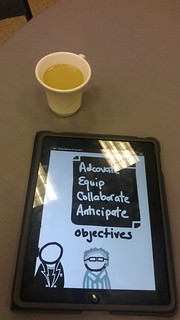
Mobile Ministry Forum Consultation 2011 Sketchnote

The 2011 Mobile Minsitry Forum Consultation occurred a few weeks ago and was certainly chock full of presentations, connections, and insights. Per our usual fare, there’s a sketchnote containing all of the moments we attended during the 2.5 days. Check it out, and look forward to detailed stories about some of the ministries and their efforts in future articles.

Got comments? Let’s hear them here and on Twitter (@mobileminmag).

Understanding and Differences Between Internet Ministry and Mobile Ministry

Am writing this a few hours after listening to Dr. Markus Pfeffier from Regent University give a talk on the implications of the Internet and virtual environments. Much of this talk I’d already known, but both the speaker and audience were more unfamiliar (association and generational differences). As I listened, I wrote a bit of notes on items covered and not covered and realized by the end that much of what has been, and will happen, when mobile is added to the list for many of you, is that you will draw mobile into the same body of work as you do Internet ministry activities. There is some overlap, but not quite the same.

Let me summarize by restating the tweets (@mobileminmag) that relate to this point published before the writing of this piece:

This morning, listened to chat about the 6th mass media (web) & the need for a ministry response; good to hear others in this space…

Despite talk, still feel that simply shooting for web and social media is a miss for all but a few economies & generations, mobile is better… Mobile includes what we know (& are learning) about Internet as media/medium. Some of us would be good to skip to mobile, then bridge back…

For many, Internet ministry is stuck as a visual/screen ministry; mobile by nature moves well beyond that to spatial experiences… When media moves beyond screen, we get audio, behavioral (gesture), & even potential for smells to augment reality of faith experiences… But, to think like that means you need to know how your biological body functions; that’s the key to understanding mobile… Remember, currently the reach for mobile (individual accounts) is just under 4 billion; reach for net is 1.2billion, unique cross-overs here… But that’s just numbers, mobile = personal = accountable, Internet doesn’t do that w/o analytics, tracking, or optional disclosure…

So, depending on how you see ministry = discipleship, that accountability piece plays a huge factor into where you put energies/resources… If ministry = broadcast then teach/disciple, Net is nearly perfect for channel… Then, net ministry should embrace what makes it unique for the effort… to whom it’s most suited for.

Yea, that was a lot of tweets. And if you saw that stream in the middle of it going up, things might not have made as much sense. But, now looking at the whole statement, we can start to draw some of those needed conclusions that lend towards understanding both Internet and Mobile Ministry efforts.

First, know that there is already a Body of discussion happening about Internet and mobile ministries. Web efforts such as Internet Evangelism Day, Jesus.net, eDot Geek, ministries such as Every Student, Cru, and LifeChurch are some of those voices, and associations such as GCIA, ICCM, the Center for Church Communication, and Catalyst do a great effort towards enabling and facilitating the discussion about Internet ministry (evangelism, marketing, discipleship, etc). On the Mobile Ministry side, there’s MMM, IE Day, Cybermissions, Mobile Advance, and the groups partnering within the Mobile Ministry Forum.

Second, Internet and mobile ministries are subject to cultural, contextual, and generational differences. I don’t subscribe to the terms digital native/digital immigrant (mainly because there is no validated research to prove it, and it’s an assumption based on 100% equal access and ability which is totally not the case). I do subscribe to the differences which can be and continue to be understood when we look at economic class, gender differences, cultural transformations, urbanization/environmentalism, commodities management, change management, and other social sciences which tend to do a decent job of describing the differences that lead to our different uses and applications of communications technologies (yes, that’s supposed to be communications with an ‘s’). You have to understand those pieces in respect to the unique qualities of Internet or mobile. Generally speaking, mobile builds on what you understand about Internet when viewing both as participatory/event communication mediums. Trends point to being able to understand this data, then creating the avenues for appropriate products and services to be developed/enhanced.

About Internet ministry being visual: I am being mean, but truthful. Curent Internet ministry efforts start with visuals. This is either the readability needed for engaging in text-driven Bible apps, social networks, or multimedia streams (ever wonder why audio ministries rely on you needing to read text to download an audio message), or the implementing of the structures which foster digital story creations. Unfortunately, this leaves out those who might have access, but cannot read. Or, leaves out those who don’t have access because they don’t have the terminal with which to engage Internet-first ministries. Mobile, being that it has built on the Internet as a participat-media channel, does much of the same. However it’s not, nor should it be limited to visual-first efforts. That’s worth another article to dive into. But it starts at a basic question, whom are you limiting access to the Gospel to because of what you know or don’t know about those who touch that channel? And if you are going to go visual, at least follow accessibility best practices for the web.

The global reach for mobile is currently almost 3x that of Internet. The purchasing power of mobile is collectively greater than that of Internet. The logistical savy of Internet-based efforts is more mature than that of mobile, as are the tools, services, practices, and standards that make those happen. This means that specific engagements on the Internet have a better chance of success towards some groups more than others. However, you are limited by being online. Unless the effort starts online and is able to get offline, it can only have an effect in that virtual space (the Kiosk Evangelism Project, Door 43, and Open Church projects actually seeks to address this specific limitation/opportunity of Internet efforts).

Therefore, how you (your culture, your generation, your bias) defines minstry will determine how Internet or mobile ministry can play a part in your efforts. It’s possible to do both, but not possible to pigeon-hole yourself so long into one that the other isn’t relevant.

Taking from Dr. Pfeffier and Tomi Ahonen, Internet is the first participatory mass media in the history of humanity (you can argue the performance stage was its precursor), mobile is the second. What Internet ministry cannot do in terms of personalized (not algorithmic) attention, mobile can. What mobile cannot do in terms of being standardized across every device, Internet evangelism efforts can. They aren’t the same. Yet, in order to see digital spaces here and beyond (augmented reality, virtual reality, and cybernetics for example) as opportunities for ministry efforts, knowing this is key to making the most of your time and resources.

Mobiles, Cameras, Pico-Projectors, Presenting and Learning

Some years ago, the year when I attended both the BibleTech and VSN Leadership Conferences, I did something that was weird to some, amazing to some, and confusing to others: I plugged my mobile into the projector, and using a Bluetooth keyboard or joystick, was able to control the presentation (see the VSN video). This has been quite normal for me in terms of presenting, and I honestly have gotten all kinds of bent out of shape when the projector or my connection to it isn’t able to be done (for example, this year at GCIA).

Nevertheless, it just makes sense with many of the mobile devices that we have in our hands these days – and yes, I’m speaking towards most of you with smartphones. You really can get away with doing simfielding rural, urban, or educational mission fields. Its honestly not that complex to do, and is more or less a matter of making sure that your method of presenting the content and having enough power for the projector is taken care of.

Now, there’s a preliminary case study over at Mobile Active talking about this activity in rural India for educational initiatives. And I’m pretty sure that I’ve poked at the Kiosk Evangelism Project enough to consider this as a primary method of displaying and enabling interactive content in some contexts. But, I’ll leave that for you to explore and figure out.

For now, I’m going to take the next step forward in how I do presentations from my mobile (right now using an HTML-driven slide-show system, with short-URLs and QR Codes to incite interactive moments for additional exploration during presentations). You might not be going that far, but if the device is in your hand, you’ve got a responsibility to figure this one out if that’s how your field missions function.