Streetlights Urban Audio Bible

Came across this the other day via 8Bit’s Twitter stream. Great project and even better approach to audio bibles than what I’ve seen personally in some time.

From their website:

Streetlights is an urban audio Bible that seeks to combine the breathing words of God with authentic and quality music production influenced by the cultures of the inner city. It is a tool that can be used to hear, memorize and assist youth and young adults in studying the Scriptures. Eclectic Hip-hop beats will be composed as an urban score to the Bible. Chapter by chapter, multiple voices with many different accents will be heard reading Scripture as the beats create a canvas for the text. Imagine God’s Word shining its light through mp3 players, social networking sites and speakers throughout the cities worldwide.

Learn more, download the sampler, see other videos, and definitely support this project that aims to not just share the Scriptures in an accessible manner, but addresses the hearing of the Word to those who aren’t able to read it (for whatever reasons).

One Industry, One Country, Two Views

Some weeks back, we pointed to a story from CNN noting the effect of mhealth and mobile banking services in Tanzania. Later, we posted a book review which pointed to the need to carefully think and educate towards the implications of mobile in the same country and region. One industry (mobile), one country (Tanzania), but two viewpoints towards the effect of mobile – how does one reconcile such divergent analyses?

Defining Mobile Ministry (again!)

Let’s take this back to grade school and fractions. When you were looking at problems with different denominators, you would first need to get your fractions common to one another. For our discussion, are fraction has the common factor of mobile, but the deonminators speak in one case towards social needs and the other towards social implications. We should then look back at our definition of mobile ministry to better frame both of these matters:

Mobile ministry is the skillful use and application of computer technology classified as mobile for the context of fulfilling the Christian (religious?) designation of forwarding the proclamation of the key ideals and history of the faith, following form to and innovating on top of cultural and faith traditions within applied contexts.

Note the skillful use being advanced by both of these stories – people are using mobile as a means to connect to one another, connect to life saving services, and in many cases are doing so in a context where connectivity and communication was traditionally bound to some specific restraint. Also note the implications happening because of mobile – relations between different culture groups are falling apart, the costs for mobile as an access point is greater than sustainable income levels, etc. As we said before, there’s an activity that’s happening, but its very much being defined by the how not just the what.

We see in the mHealth/mobile banking story the aspect of meeting needs (Matthew 25:35-40). We see in the second story a side effect of meeting needs. Ministry has happened, and lives were (saved) enriched, but doing so opened holes in the social structures which meant that the application of the Gospel had to go beyond the initial addressed need, and now needed to account for the side effect (economic and spiritual artifacts/abuses).

Defining Cultural and Faith Traditions

Look back at our extended outlook for both the definition of mobile ministry and 2011. Note this key point about areas where the Body needs to become more aware and knowledgable:

Spiritual implications of connected spaces: theological constraints/precedents; directions for educators/parents/local communities; psychological/cultural effects of mobile vs other personal/connected technology media elements

It isn’t enough to just apply a technology, but as is noted in both stories, there are cultural and faith traditions which must be observed and followed if the technology and its artifacts are going to have a lasting effect.

We can make some assumptions, as both CNN and Goliama do in their respective pieces. We can’t get the entire picture by just looking at one of them. We’ve got to take into account that there is a rich cultural and historical narrative to which mobile (and health, banking, politics, etc.) is being grafted onto that will further color what’s happening here.

Reconciling to a Picture of Tanzanian Mobile Activity

Tanzania is a country – not a neighborhood. Therefore, we can’t assume that activities happening for one group or in one area of the country are happening with the same fervor (if at all) in another areas.

The common denominator here is that the introduction of mobile in Tanzania has caused disruptions in the social fabric of all those who have or interact with those who utilize mobile devices.

The conclusions for the minister (missional, evangelical, doctor, or otherwise) have to start from there. If you addressing the people of Tanzania (or any country), and wish to engage them with the technologies of their day, does your approach start from a generalized view of the people and their technology, or is it grounded in a methodological evaluation of general and specific issues relating to the sub-groups to which you will be interacting with?

In respect to these stories of our Tanzanian family, remember these key points about mobile:

  1. Mobile is the first personal mass media
  2. Mobile is permanently carried
  3. Mobile is always-on
  4. Mobile has a built-in payment mechanism

These are four of the eight characteristics that mobile has and will effect the user and their immediate environment. You can’t get away from the fact that there is an effect. Making sense of it, and then pressing forward to display the Gospel, is what ministers are called to do. What pressing forward will look like, is dependent on what viewpoint of mobile is best served by the environment you are called to be involved in.

Talking Accountability with Mobile

Over the past weeks, we’ve traveled and talked about MMM a good bit. Some of the more interesting conversations have come when we’ve talked about accountability as being an aspect of mobile ministry that has to be better understood, and then lived out. What follows is some discussion on the topic.

What is Accountability?

Depending on your experiences, the term accountability might conjure up several types of images. Some might see an overbearing parent, or others might see their vices skillfully hidden. Some might hear accountability and only think in terms of opening up about sexual sins, or maybe the term points to finances – the term checks and balances rings in one’s mind there.

In many respects, you can say that thinking about accountability with mobile includes these and other areas. But, let’s start with a definition of accountability, and then move towards mobile from there.

According to Merriam-Webster, accountability can be defined as:

an obligation or willingness to accept responsibility or to account for one’s actions

This seems very terse and simple. An obligation – meaning that it is not voluntary, requires obedience, and may contain consequences. A willingness – meaning that you have some positive yielding of your expectations and desires towards this – if you will, your behavior bends to this direction versus away from it. Responsibly – points to a boundary, a metric of judgement, and ownership. And the word account – which speaks to there being some kind of recording, which may or may not be written, but is noted somewhere.

What do we mean by mobile accountability?

So then there’s mobile. When we opened the discussion last fall about the definition of mobile ministry, we also defined mobile. Here’s what we gave then as a definition:

personal computing use that is defined by time, task, and spatial relationships, and is not limited to a device which maintains a wired connection; behavior of use is not limited to non-moving contexts; viewport of use is established by a 1:1 ratio of device/service and user.

Notice some of the similarities here with the definitions of mobile and accountability:

  • Both are bound to an owner
  • Both have an indicated user, tool, and behavior
  • Mobile means that you are connected to a person and/or service – which is monitored for billing, analytics, and advertising

In effect, mobile then has this context of use where by its very nature, its personal and recorded. What happens though is that we can sometimes get so lost in the personal nature of mobile that we don’t realize that there’s an accounting of our use that is being logged. We know that these things happen because they are properties of using mobile. And (hopefully), we are using mobile within the constraints of what is good, holy, and acceptable.

Mobile accountability therefore means that we understand that there are technical, personal, and community layers that may call us into account of our use of mobile devices and services.

Acts 5 Demonstrating Accountability

Recall the story of Ananias and Sapphira in Acts 5. At this point in the early church, the practice (behavior) of sharing possessions. This was an action taken on by new believers of their own volition, and most willingly gave – not just an account of what they had, but relinquished the ownership of these possessions to the management of the Apostles for distributing to all.

Ananias and Sapphira gave, but held back. They weren’t transparent with their dealings with the Apostles, and when called into account for this, they did not own up to their responsibility, and therefore the obligation they placed themselves under was done under false pretenses. In their case, they lost their lives. Not because they weren’t being accountable, but the report that spoke of their actions didn’t match with what they were providing.

Why then is Accountability an Important Topic in Mobile?

So back to this term accountability and what it means in the context of mobile. First off, understand that you are under no obligation to share with anyone what you do on your mobile devices. It truly is a personal window and communications portal.

You do have a responsibility to understand also that all that you do on your mobile device is recorded. Your carriers keep a record of all of the voice, SMS, and data passed through your web browser and other applications which connect to the Internet. You might also have a record of your dealings kept by various service providers. For example, Google will show you on your account page the various IP addresses that have accessed your account.

You also have a responsibility (some would even argue that its an obligation due to the life that is redeemed that is no longer your own) to use mobile devices and services in such a way that your community (family, friends, employers, etc.) can call into account your use of mobile –  and you can answer truthfully of the successes and/or struggles that you might be having. Whether you observe or not observe that responsibility will open you to consequences that you might not be ready for.

In Romans, Paul exhorts the believers listening to the reading of that letter to present their bodies as holy and acceptable to God (12:1). He regards it as a reasonable service – an obligation that we willingly take part in as part of our responsibilities gained as part of this new life in Christ Jesus (8:1).

If this is the case, then to be accountable – even on mobile – is an act of sanctification and worship.

What Next, or How Do I Be Accountable?

As we said at the outset, the term accountable may have several connotations. All of these can be addressed, and here are some examples to follow through:

  • There are mobile applications which can filter content and send a report to a trusted friend. We’ve listed two on our Bible Apps page: Covenant Eyes for iPhone/iPod Touch/iPad and X3 Watch for Android and iPhone/iPod Touch devices*.
  • Consider starting a prayer chain in your churches or small groups by using SMS (text messaging). Have one person in the group send a prayer request to 3-6 people, and those people commit to praying for, and then responding by text, call, or face-to-face visit to follow-up on the matter.
  • Reduce or remove those features on your mobile device which might be straining your wallet or mental state. Most carriers allow for you to remove services such as Internet from your account after a certain amount of time within your contract.
  • Consider getting rid of your smartphone and picking up a simpler feature phone that has fewer features and therefore increase the ability for you to use your mobile device for destructive behaviors. In this case, make this decision after speaking with a pastor or counselor, then be sure to follow-up with regular progress reports.

At the end of days, when we stand before the throne of God and Jesus sits with the Book of Life (Revelation 20:12), our life will read like a mobile phone bill, but with greater detail of the charges and a much higher final cost. Just because mobile makes you accessible, and your actions might be personally viewable, doesn’t mean that even there, its not being accounted to you.

*If you are a company that deals with accountability software for mobile devices, please get in contact with us so that we can add you to our listing.

Retweets of the Week (Jan 23-29)

Once again, here’s a listing of some of the items which we’ve found via Twitter which may or may not make it into future articles. These tweets are respective of some of perspectives and voices that speak to the mountain of relevant issues at the intersection of faith and mobile technology. Our sharing of them here is because its a good chance that you could have missed them, or that you might not be active on Twitter, but appreciate where our ears go in relation to content here.

With that said, here are our latest Retweets of the Week:

Ew4n – Our man @momchil_MIR drives a keyboard, mouse, USB hard drive, HD monitor and JBL audio from his Nokia N8:http://bit.ly/fX1YS0

dmlcentral – Teaching with a digital tablet: one educator’s story. “Students participate who did not participate previously.” http://bit.ly/gA6Hpj

disruptivedean – What is UK citizens’ backup plan to maintain Internet conx in Egypt-type scenario? Need a decentralised mechanism like non-telco WiFi meshes

PBSMediaShift – Why And How Digital Music Products Have Indeed Failedhttp://j.mp/hPrnlD by @Mark_Mulligan

kcambell – If Internet helps engagement, should NPs prioritize better digital comms or increase base by narrowing digital divide?http://bit.ly/eMEEZt

lifechurchtv – James 1:26 “If you claim to be religious but don’t control your tongue, you are fooling yourself, and your… http://fb.me/ODxFiQAp

Padmasree – Hyperconnectivity is not just about connecting people – how does m2m connectivity change industries, govts?

3GDoctor – “Household Penetration Rates for Technology Across the Digital Divide” http://t.co/3m3

Mobile_Advance – RT @kiwanja Nice Economist article on low-tech services on mobiles in the developing world. “Not Just Talk”. http://is.gd/udFTRv#mobmin

futuresagency – RT @MartinStrickman: Apps 2 help addicts disconnect from the web: MacFreedom, awayfind, rescuetime, getconcentrating via @loic #Davos #WEF

GordonMarcy – Is there a better way to keep up with rapid change? “The Great Church Run for Technology” http://bit.ly/f126F8

TrueConvert – Are Paper Books Going the Way of the 8-Track?http://post.ly/1Xdgm

CMAResources – The question isn’t where you go to church but where does your church go #missional #organicchurch (RT @Blackbirdnet)

anthonycoppedge – CHURCHES: Does your church use “QR” codes (barcodes) in any communications/formats? // Interested to hear your answers.

That’s just a few; I realize that this list gets a bit long, but we really do spend time looking at these and other links published at Twitter and via other outlets. If you’ve got something you deem worth sharing, be sure to point it out to us (@mobileminmag) or use the #mobmin hashtag if its directly related to mobile ministry efforts.

Diversity of Gifts, Diversity of Opportunities

There are different kinds of gifts, but the same Spirit distributes them. There are different kinds of service, but the same Lord. There are different kinds of working, but in all of them and in everyone it is the same God at work. Now to each one the manifestation of the Spirit is given for the common good…

1 Corinthians 12:4-7 NIV

When we’ve dived into defining mobile ministry, we’ve been very intentional about looking at some specific applications of mobile in ministry contexts, while keeping a consistent definition in place. The reason for this is that if mobile ministry is going to define opportunities, then we have to make sure that the same lens for its definition is given to its application.

As the verses from Corinthians illustrate above though, there’s always going to be a diversity of approaches that will matter towards the same goal(s) – utilizing the best of people and mobile technologies to expand the effectiveness of the Gospel.

While we are intentional here about looking at mobile through a specific lens, let’s not forgo other potential intersections which also will be ripe with opportunity, and impact.

Retweets of the Week (Jan 16-22)

Twitter logo and birdA bit late for these since traveling and projects were in front of things. But here are some of the items we’ve retweeted last week.

Make sure to follow us on Twitter (@mobileminmag), Google Buzz, or by using our mobile app in order to see these as they are posted. You can also send us content through those channels.

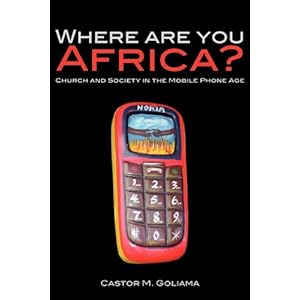
Book Review: Where are you Africa? Church and Society in the Mobile Phone Age

Contributed book review of  Where are you Africa? Church and Society in the Mobile Phone Age by W. Stephen Keel.

http://ecx.images-amazon.com/images/I/41Z-19-uoOL._SL500_AA300_.jpgSpeculation regarding best practices for mobile ministry is rampant. Learning from someone on the ground is the best source of meaningful insight. Castor Goliama, a diocesan priest of Songea, Tanzania has provided me with more insight than I expected to receive. His December 2010, book release, Where are you Africa? Church and Society in the Mobile Phone Age is focused on Africa and specifically Tanzania, but it may very well shape the discussion of mobile ministry for remote poor people globally.

Mobile ministry buffs are almost always techies. They are turned on by gadgets and innovation. The warp speed advances of mobile technology makes looking at the latest model or feature tantalizing. Castor Goliama has issued a call to look at the spiritual realities influenced by this exciting technology. His writings have forced a course correction for at least one technophile, me.

The major myth that I have been forced to abandon is the idea that the cell phone surge was caused by the economic benefits to cell phone users. Two years ago I read that poor families in India were experiencing 15% increases in household income within the first 30 days of owning a cell phone. I have quoted this statistic many times. While it may be true in India where the government has kept the cost of minutes at or under $.02 USD, tariffs in Tanzania and other African countries have become a tax source where normal tax collection is difficult or impossible. A family earning $1 USD a day may end up spending up to 40% of their household income on 40-cent-per-minute minutes. Rather than benefiting them financially, they are frequently going without food to talk on the phone. Apparently, only about 15% of cell phone users actually use them for commercial purposes.

Fr. Goliama shows us that people endure this economic hardship for a more valuable benefit, the knowledge that their family members are safe. This is a penetrating insight. The rural poor are not wallowing in the latest tantalizing tweet. They are probing for comfort that their loved ones are OK.

The title of this book provides signature insight. The rural poor do not have the luxury of indulging in social niceties. The standard question, “How are you?” takes too many expensive minutes to answer. It has been replaced with the far more efficient question, “Where are you?” The answer provides instant insights to a family member tracking the well being of a daughter or wife. When minutes are astronomically expensive, users resort to ring code to communicate. 1 rings from mom means, “Call me now.” 2 rings may mean, “I am fine.”

The need to examine ministry standards in the light of regional realities is truly underscored by this important book. Western media producers frequently attempt to sensitize themselves to potential cultural mistakes in the content they produce. While this is a dearly needed discipline for media production, spiritual mobile ministry, according to Fr. Goliama, is influenced by a far more significant question. How are people actually using their phones and how can the church influence these use patterns to build the kingdom of God?

I have been working for several years to promote mobile ministry, largely from the comfort and security of my wonderful home in Virginia. Despite repeated trips to countries that I would serve, I had to read this book to learn something that is not immediately obvious. I and most of my fellow techies have been impressed by the shocking growth of mobile phone subscriptions in very poor countries. I have occasionally wondered how these poor people could afford even the least expensive cell phone. Fr. Goliama unraveled the obvious truth. They can not afford cell phones and they do not own cell phones. The ratio of cell phones to cell phone subscriptions in Tanzania is 1 to 60. One person owns a cell phone and 60 people use their cards to access that one phone.

As world planners anticipate smart phones for the majority of the earth’s population in a very few years, a vast sea of people are pinging each other with unanswered rings. This begs an answer to the question, how can the church use mobile technology to reach these people?

Goliama has done us a great service. The first part of the book explores in depth communications and cultural relationships prior to the cell phone. The historical role of radio, hand or solar-powered media players and outdoor movie sessions is discussed in depth. The middle part of the book focuses on how the phone is being used and how it is redefining personal relationships and political activism. Viral musical ringtones have actually influenced elections. The book concludes with a look at theological implications manifested in the brave new mobile world. It is decidedly Roman Catholic theology with an emphasis on social responsibility as contributing members of communities as opposed to our being individuals seeking our best possible personal rewards on earth and in heaven. It also seeks to ask hard questions about the very nature of “church”.

What am I doing differently having read this book?

I am changing my perspective. While I remain interested in the proliferation of inexpensive bandwidth and the portability of file formats between cell phone models, I am now praying for spiritual insight into how what happens on the phone actually builds the kingdom. I want to leverage the ways that phones are actually being used. One speculation has arisen from my prayers for insight. I am now interested in seeing indigenous evangelists being given cell phones instead of bicycles. While he could use a bicycle to get out to meet people, a phone could bring as many as 60 people to him. He can provide them with a chance to know that their family is safe and tell them about the safety to be found under the shadow of the wing of the most high God. I will be testing that idea on a pastor from Kenya this evening.

My hope is that Where are you Africa? Church and Society in the Mobile Phone Age will make me a more profitable servant as I meditate on the lessons I have learned from reading it.

For more information and to purchase Where are you Africa? Church and Society in the Mobile Phone Age visit African Books Collective, Amazon, and other places online.

W. Stephen Keel is a seasoned minister of the Gospel. A resident of Danville, VA, he currently heads the Kiosk Evangelism Project which aims to address the need for indigenous and freely available Bibles, videos, and audio for communities to which the Gospel and Jesus Christ is injected.

*This article has been updated from its original posting (minor corrections, etc.)

Mobility in the Midwest ~ Fear Part 1

Fear. Fear pushes us forward and pulls us back. Fear can be as tangle as the person sitting next to us on the bus. The Urban Dictionary has an interesting definition for fear that I think applies to the topic that I am about to talk about.  “Fear is the mind killer. Fear is the little death that brings total obliteration.” What is in our mind is often worse then what is in the real world.

When I talk about new technology in the Midwest, most peoples eyes glaze over. Because here is a dirty little secret that I try to hide. I would say 70% of the homes here still have the rotary phones the phone company installed on the wall in the 60‘s. Say it aloud “ro-ta-ry phone”. It takes 5 minutes to dial a number and if you mess up in the middle, you have to hang up and start over. So talking about phones that do not have a key board to dial on instills a tangible fear in the listener. A few steps were skipped. How we get push past this fear of moving too fast?

We acknowledge that fear. What people think about technology without having used it is far more threatening that what reality ever could be. We help them face it. Then we walk them through it. Fear should not be what holds back people from progressing forward.

I have to be gentle with my fellow neighbors in the Midwest. Less bull in the china shop and more gentle sheep that children pet at the fair. I put the technology in their hands, on person at a time. People aren’t going to ruin my phone by playing with it and I let them touch it. I take the time to explain what it can do for them. Easing one fear after the other, till the only emotion that is left is excitement.

Next week, Part 2 will touch on the topic of fear of success in the Midwest

Inviting the Commentary Culture

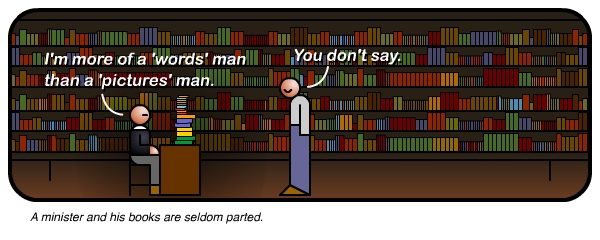
Words Man - A minister and his books are seldom parted, via ASBO JesusWas over looking at the older posts at ABSO Jesus recently and came across the link to another pastor’s website. He wrote this great post on the type of culture that we now have an opportunity to foster with the communication tools that we have available (Internet, social networks, etc). He calls it a Commentary Culture and I would totally vouch for seeing more of these. Here’s a snippet of the post:

…There was a time when the sermon was kept under wraps until the moment when, like a new car at a motor show, it was revealed with a flourish. Our particular sermon has emerged from an  online conversation which has grown during the week. On Monday, the preacher sent a message out across the social networking landscape to say what he was working on and to ask for prayer. By Wednesday the prayer request had turned into a resource enquiry – asking where a particular illustration could be found. By Friday that illustration had indeed been found, but replaced by another one, far more suitable. By Saturday, fellow preachers had been shown an outline of the material for their own consumption, or as an aid to their prayer. On Sunday, the sermon is preached…

Read the rest of A Commentary Culture at Richard Littledale’s Preacher’s A – Z

What are your thoughts? Does mobile/web invite a commentary culture or would you rather keep the conversation behind sermon prep behind closed doors and next to large libraries?

The Phones Show

Though it has been a good while since we’ve done a review, that’s not stopped the release of mobile devices that have some ability to shock and awe at various turns. One of the best demonstrations of the shock value present in today’s mobile devices is found on The Phones Show.

Steve Litchfield is the voice and producer behind The Phones Show and every week (or so), he publishes a new show.

Its not a show meant to talk tech for the latest and greatest, but for the normal/near-normal mobile phone user. Take a look at Episode 128:

One of the best parts about The Phones Show is that its recorded using mobile phones. These days Steve uses the Nokia N8 and Samsung i8910 HD as they both offer an impressive amount of video and audio quality.

Catch up with this and other episodes of The Phones Show by visiting their website. You can subscribe to it via iTunes, or your podcast/RSS reader, ensuring that you get the latest video when its released.