Monthly Archives: May 2013

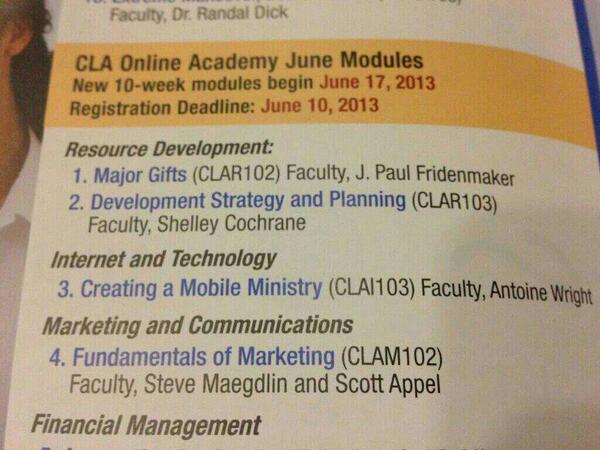
Register for my online class on Mobile Ministry – June 10 Deadline!

Straight from the folks at the Christian Leadership Alliance, this is something (else) that I’ve got on deck in the coming weeks:

Do you have a mobile strategy? If you aren’t maximizing the use of today’s technology, you could be missing one of the key ways to fulfill the kingdom mission God has given to you as a leader. That’s why I want to invite you to register to attend the 10-week online class I’ll be teaching this Summer in the Christian Leadership Alliance Online Academy. This module, powered by Azusa Pacific Online University, will help you to establish a successful mobile ministry. The best news is that CLA’s online classes are designed in a way that works well with your Summer schedule, allowing you the flexibility to coordinate your studies around your schedule. Sign up today to reserve your spot – June 10 is the registration deadline. www.ChristianLeadershipAlliance.org/Online

Registration deadline – June 10
First class – June 17

Creating a Mobile Ministry: Mobile Ministry Introduction and Relevance (CLAI 103)

This module, led by Antoine RJ Wright, Founder/Primary Voice, Mobile Ministry Magazine is designed to provide participants a better understanding of mobile technologies used in ministry. We will explore mobile technologies and behaviors which influence faith practices within Christian and other religious spaces, with the goal of creating a theological and sociological framework for analyzing, discussing, and leading local/global communities in mobile interactions. The participant will have the knowledge and foundational skills to supplement existing ministry activities, or start new ones which utilize mobile technologies, communications, and/or behaviors.

And check out the 12 additional modules CLA offers this Summer in the areas of Board Governance, Financial Management, Executive Leadership, Marketing & Communications, People Management & Care and Resource Development: www.ChristianLeadershipAlliance.org/Online

This entry was posted in Uncategorized on by .

Moonshots

A series of articles that sit near my reading pane have me thinking a bit. I want to knit them into a question that I feel mobile and internet ministry need to solve that’s more important than spreading the Gospel.

“Shape the digital world or robots will do it for you”

That sounds like something out of science fiction novel, or a futurists’ website. Its really from the latter, because the former is no longer fiction. The abiltiy to build and program machines to do transitional tasks isn’t reserved for a particular person or people group. Its something that anyone can do. When we go about creating more and more of thse automated spaces, then we have to come to another bump in the road: are we the product of what we program, or does what we program project who we want to be?

“…If there’s an enormous problem with the world, and we can convince ourselves that over some long but not unreasonable period of time we can make that problem go away, then we don’t need a business plan,” Teller says. “We should be focused on making the world a better place, and once we do that, the money will come back and find us.”

I’m sitting at some kind of cross-roads where I know that I want to continue on this course with MMM, but not as it was done before. I want to be like Google X is described as in this Business Week piece, a place where its not just building or disecting mobility in ministry for the sake of it, but actually challenging and answering the problems that present themselves most at this intersection of faith and mobile tech. For example, why does someone need to know how to read in order to receive the Scripture? Shouldn’t all they need to know is how to ask from their device and the representative services make the answers available in the best possible manner. That’s how John Dyer’s Bib.ly service works in terms of presenting various sources for Bible verses. Why isn’t that pushed even further so that I’m not spending time trying to figure out how to translate, but how to share a recipe for a favorite dish that makes the salvation conversation something that just happens to save a whole house.?

“From my point of view, technology is not only your computer on your desk anymore, it’s part of your life. It made sense to me to have a design that felt more accessible, that didn’t make you feel all the time that you’re just reading a tech magazine…”

I feel the same way about reading a bible on a mobile device. I’ll use my Sermon/Bible Study Notes archive as an example. I don’t need to necessarily read the Scripture again, but I do want to experience what was going on when I did read it. I want to have the pictures, images, and even video that speaks what is going on, just as much as I want the links to the content from encyclopedias, news articles, and academic journals that challenge the very thoughts that I’m being exposed to. And then when all I do want is a basic instruction before leaving earth note, can it come to me in a way that is accessible to the moment, not one that makes me change into someone else’s designed point of view.

If all we are doing is repacking the printing press or radio broadcast, then we aren’t doing anything that gets people closer to God. We are called to be like moons and reflect the light of the Son. How about we start designing, collaborating, and connecting using the web and mobile tech as if we are reaching for something more? What are the moonshots in this space?

Let’s start with one that I can’t believe has never been designed: turning a mobile phone into a magnifying glass for your Bible (there are magnifying glass apps, just none that purpose into helping folks read those nice small print bibles, go figure). What happens if in the effort to teach people about mobile in ministry, we simply just enable them to see?

This entry was posted in Uncategorized on by .

ICCM USA 2013 (3x the MMM)

In the coming weeks, MMM will be heading to the ICCM USA Conference in Taylor, Indiana. And as with the last two conferences, the focus on mobile makes for a decent opportunity to share insights and forward areas of discussion. For example, a conversation at ICCM last year led to the acquisition of a Nokia N950 and a few conversations on open source technologies used on the mission field.

At this coming ICCM event, MMM will be in the mix for at least three of the mobile sessions happening, and given their topics, it should make for some interesting pathways forward.

The first talk MMM will be in on is called The Theology of Mobile Ministry. Here’s its abstract:

The speed of acquisition and use of mobile devices presents a sociological argument for understanding mobile ministry. The emphasis on services and applications presents the technological arguments we are already well familiar with. This presentation will present some of the theological points for understanding and engaging mobile ministry.

A theology-first discussion on mobile tech? Yup. And I’m hoping that it will lead towards an opening of tech and faith discussions on this wise outside of the academic community. This is a topic designed to fit alongside our goals for 2013, so this conference probably won’t be the only one that this information is shared.

After that session, MMM will be leading a panel discussion on the subject of BYOD (Bring Your Own Devices) and what that means for your ministry. This isn’t totally a new topic (think: laptops), but it has caught all kinds of positive and negative press because what it has meant towards IT teams supporting efforts, folks on the field making evangelistic efforts, and ministry leaders who want to stay on top of keeping all of this activity cohesive.

The third and final topic that MMM will be facilitating is a mobile workshop titled Sharing Content FROM Your Mobile.

The challenge for many ministries who want to go about using mobiles in ministry is that the practice of sharing info when on the field doesn’t match what’s done at home. This will be a workshop demonstrating methods of how to share content from mobile devices using several conventional and unconventional methods. Attendees will be active participants and all will be required to use some kind of mobile device during this session.

Now, this seems like it would be one of those easy topics, but the audience attending ICCM works in places where doing something like attaching a file to email, sending a Dropbox link, or even throwing up a server, just doesn’t make sense. Where the wrench happens here is for those groups who are ministering in communities which already have a significant mobile base who is sharing content, but they don’t know how or what’s going on. This workshop will have folks learning how to share content from their devices right in the session, with some notes about what’s happening in the ministry space around them.

At this point, I do have to apologize if you’ve not heard of ICCM before and this is a conference that you want to attend (were you not subscribed to the #mobmin Calendar). Registration is closed. We’ll do our best to make sure the presentation decks to hit the site right around the time the presentations happen on our end. You will want to stay tuned to the ICCM website and its social media hubs for other presenters’ decks.

About ICCM

The International Conference on Computing and Mission (ICCM) is an annual informal (NOties allowed) gathering of women and men who have
a common interest in computers and mission. We share a vision of cooperation for effective use of technology, bringing the Gospel to every nation.

This conference has been going on for almost 25 years, and from what I understand from those who have been there many times, its always a point of not just hearing something new, but being refreshed towards ministry efforts personally, in family, socially, and in organizations. Yea, there’s a helping of geeks whom are there, but its always quite friendly no matter where you are technologically.

One thing that I will note, just in case you miss this one and want to come to another. ICCM is a family-friendly conference. Meaning that there are several attendees who bring their kids along (a couple on the planning team brought their new addition to the conference last year). I’ve noticed that there are women-only sessions, there was a psychologist there last year to help with personal/internal items, and there’s always a section of the time devoted to prayer in small groups and community worship. Its indeed not a normal conference, and at the same time, its how the Body connects with itself.

For more information, including conference information about the Europe and Australia editions of ICCM, visit their website. And if you will be there in June, I look forward to connecting with you there.

This entry was posted in Uncategorized on by .

Ministry in the Digital Age, IE Day Contest

Ministry in the Digital Age

Was good to see this note of Dave Bourgeois’s book Ministry in the Digital Age now being available.

…What are the best evidence-based practices to implement? How do you best truly integrate digital, rather than just bolting on a few social networking options to an unchanged structure?

For these things are no longer optional luxuries. Any ministry or non-profit without an effective digital and social media policy, owned and understood by the whole team, is doomed to near invisibility and likely failure.

Dr Bourgeois takes you through both the strategic planning and the practical steps for implementation. On his book page, he explains the background to the book, with an online preview of the introduction and appendices…

That news was found via our friends at Internet Evangelism Day, who also highlighted that post with a contest to win a copy of Ministry in the Digital Age. Here are the details:

Do any of these things before the end of May, then email me to say where I can find it along with your postal address, and the winner, chosen at random, will receive get the book:

  • Tweet about this page using this ready-made link, or include the #ieway hashtag
  • Share this review on a Facebook group or personal page
  • Link to or republish this review (an edited summary is fine) in a blog
  • Syndicate our blog posts to your Facebook personal or group page using Networked Blogs
  • Embed our daily Paper.li news roundup into the margin of any webpage or blog – just copy the code from the ‘Share > embed this newspaper’ link at top-right of Digital Evangelism Resources.

Makes for a solid investment, and once my summer swing gets done, I’m sure we’ll have a copy of this in hand to get reading on as well.

For more information about Dave Bourgeois and his work in digital ministry, check out his website and see the fruits of that work with the Biola Digital Ministry Conference.

This entry was posted in Uncategorized on by .

Renew Outreach’s Mobile Media Conversion Training Center

The folks at Renew Outreach have been kicking out the activity in mobile ministry lately. From our literal witness, they’ve gone from having a passing impression of mobile for ministry in their space, to becoming an on-the-ground leader towards enabling their ministry activities forward with the aid of mobile ministry techniques. One of the features they’ve introduced that really impresses me is a Media Conversion Training Center. The Media Conversion Training Center is a “step-by-step guides to convert Gospel media (whether that’s the Jesus Film, the audio Bible, GRN, other media or your own creations) into formats that will play on various different platforms.”

What’s really neat about this training center is that its not only for the content that Renew has for their devices, they’ve essentially given some depth to standards for mobile media distribution for anyone. See the below images for what they are doing:


The fruit of that work can be seen in this video produced by Renew from work in Inquitos, Peru:

Really neat work and something that many ministries have been looking to do for sometime. Renew has been working on a series called Mobile Ministry in Action which gets into more specifics about these activities and what they are doing as an organization to move forward.

For more information and to engage Renew Outreach for mobile ministry efforts, visit their website.

This entry was posted in Uncategorized on by .

Identity and Depth

The other day, a friend and I were talking about the use of a call-in service for Bible searching, reading, and evangelism. In a sense, looking at the market of those folks who might be still tied to a paradigm of looking towards a voice for information (rather than having content on a screen, sent passively, or directly searched). One of the things that was striking in the midst of this conversation is how he stated that at his church, that the age and culture of the population poses some resistance towards those who use electronic devices for Bible reading in the community (a trait that John Dyer once spoke towards very well). In that, I wondered a lot about this idea about the identity of the Christian in this changing society and if there is something to be said towards these devices, services, and experiences that are gathered about these days.

You see, for those of us who pay attention to these things, there’s a clear sense that the identity of the Christian is being challenged on several fronts. Emotionally, there’s a drawing towards more expressive (some would call this transparent, others would call it performance) means of showing one’s views/feelings. Socially, there’s a bent towards urban centers in some metropolitan areas with pockets of intentional communities. While in more rural areas, there’s a bent towards a (romantic) preservation of the community and faith that was remembered by those who haven’t moved to urban centers. Theologically, it seems that just about every branch of the Church has not only gone through revisions of the text into a common language, but seen a shift from the leanings of the West towards something more charismatic and dynamic – moving south and east while doing so. All of this is happening in different shades across at least three existent generations of people groups. That’s a lot of shift to account for.

And yet, here is that nearly always present mobile. I like how Jan Chipcase squares this topic of identity alongside this totem we carry:

Much like the paradox of the toga in ancient Rome, some objects can connote high status in one culture and low status in another. A suntan on someone who lives in London or New York is a sign to others that that person can afford a tropical vacation, or at least a trip to the tanning salon. On the other hand, a tan in China or Thailand is a mark of peasants who toil in the fields. Thus on the shelves of pharmacies in Bangkok you’ll find dozens of skin products with whitening ingredients; in the United States, expensive moisturisers are tinted. Does this mean that the people who use these products are all that different from one another?

What are we saying if we are affirming or denying the use of mobile devices in community gatherings? What if part of the impact of what we are saying is that your identity has to have more depth than what you carry? We could stand to have a faith that does that. It would mean though that those making such a declaration have to be able to been seen without their totems as well.

Or, what if we said that you can carry it, but that it has to have an influence beyond just being your own screen? What does it mean when we cultivate the personal content and activity of a mobile device, but in some social situations mandate that it has an open or community-accessible aspect to it? Not just “you can see the photos I just uploaded to Facebook either,” but a more sincere – “here, let me help you understand why I took that kind of note” kind of feature.

What I thought about my friend’s declaration about his church’s specific culture is that they asked for folks to affirm the church’s identity, but gave nothing in return to those who needed a bridge to become that manifested character. If you will, “live the way I tell you, but I won’t give you my eyes to do it.” For many today, their identity is tied very tightly to what’s in their palms. The style of phone, the case on it, the ringtone, and even the applications preferred are a part of who they are. When we ask them to remove the device from the presence, we are asking them to set aside themselves for something they are not. In a sense, ignoring the traditional declaration of “come as you are.”

If I am also what happens on this little screen, then to engage the depth of who I am means that you have to be as willing to dive into me, as you want for me to unplug into you.

This entry was posted in Uncategorized on by .

Aiming Towards FirefoxOS

Firefox Marketplace on the Geeksphone

It seems to be some kind of tradition here at MMM to poke a look at mobile devices, services, or experiences that are a bit more on the fringes of what’s possible, what’s happened, or what’s coming. In that light, I think a small look at FirefoxOS, and its aims for those markets/regions where there isn’t that much in terms of smartphones makes for an interesting perspective.

What is FirefoxOS?

For those familiar with the web browser Firefox, there’s a good bit of similarity happening with FirefxOS. The former (browser) was a chance to unseat the incumbent and dominant web browser (then Internet Explorer) by offering a standards compliant, fast(er), and more expandable (through the use of extensions) web browser. In part, the goal was to disrupt Internet Explorer by making it be what it wasn’t trying to be – the center of one’s web browsing environment. FirefoxOS is going a similar route but from the perspective of being a mobile phone platform. And what it aims to disrupt are (a) the route of development, and (b) the use/marketing of the top smartphone platforms, Apple’s iOS and Google’s Android.

Disrupt the Route of Development

One of the fabled innovations of the last half-decade of mobile has been the rise of the “app economy” and the ability for those with the time, patience, and funding to get into a platform and design some kind of unique experience within it. This is nothing new to the MMM audience – from as far back as the original Bible Reader on PalmOS Classic devices, the idea of a few people learning a platform then making content or services available made a lot of sense. Over time, this evolved into offerings a places such Handango/PalmGear, Nokia’s Download! service (the first manufactuer-pushed app store), iTunes App Store, and now every other app store imaginable (seriously, look at just the list of places you can download a bible). The problem is that it left the ability to build into a select group of folks who would have a particular motivation to continue. All the while, a place to produce with a lower barrier to entry, i.e., make a webpage, continues to sprawl at an amazing pace.

FirefoxOS aims to disrupt in this wise first: if someone can make a webpage, why can’t they make an app?

Disrupt the Top Smartphone Platforms

What’s also quite true about mobile now is that for the greater majority of those who use a mobile device in developed nations (please note all of the qualifiers that I just used), when asking the question “what is a smartphone,” or, “what is your preferred smartphone device or platform,” there are only two answers: Apple (iOS) and [Google] Android.

In the midst of such an answer are the incumbents whom are older: Microsoft ( with Windows Mobile then, Windows Phone now), Nokia (with Symbian, S40, and Maemo/MeeGo then, Windows Phone now), and Blackberry. And then there are those whom are looking to jump into the scene: Samsung’s Tizen, Jolla’s SailfishOS, Cannoical’s Ubuntu Mobile, and Mozilla with FirefoxOS. The former are more or less looking not to become unrelevant. While the latter platforms are looking to grab a slice of the mobile pie inside of a world context that has shifted the priority and profitability of mobile from a Western European/USA audience to an Asian and South American one.

FirefoxOS wants to be embedded into these newer regions and environments but to do so, it has to also disrupt the attention that the leaders and incumbents have towards their platforms. Disrupt doesn’t just mean attention though, it also means shifting the conversation from what has been possible to what is doable.

Phones for Apps for FirefoxOS

Part of the strategy for Mozilla to change the conversation (disrupt the incumbents if you will), is to offer a chance for developers of any skill level to get into the stream of creating apps and services for their upcoming platform that showcase the flexibility of it, but also endear the platform to the context of the markets it will be developed into. The Phones for Apps for Firefox program that’s going on this month intends to do just that.

If your proposal is accepted (and there are still devices left), then you will have the opportunity to create within the stream of some of that disruption that FirefoxOS seems to be aiming for. And even if you don’t get into the program, there’s documentation and software available to help you get started in making this platform something worth keeping into the conversation of what’s available for you or your content.

What that means for us here at MMM is that we could jump into the fray and either develop an app (we’ve got one worth doing) or learning the platform such that we can assist others who might begin considering it. That’s not a small endeavor (we did mention all of the other platforms that are fighting for attention these days earlier). Still, it makes sense that at the intersection of faith and mobile tech that we look at what’s prime to disrupt the status quo, and then ask the question “what makes the most sense for those folks coming online, specifically through their mobile devices, as devices become more malleable and personal?” We think FirefoxOS is one of several ways to go about answering that. We’ll see what the future of mobile looks like when we design it.
This entry was posted in Uncategorized on by .

May Videocast

In this month’s video, Mobile Ministry Magazine’s Antoine RJ Wright tackles a user submitted question on mobile phone research, talks about some upcoming events, and expresses a bit of sadness at a broken tablet.

This entry was posted in Uncategorized on by .

Vojo

Vojo full logo
One of the benefits of following social media is that you come across information that has relevance to mobile ministry, but it doesn’t have to come from major publishers or journalists. Some of the best items found in this space are posted by individuals. And specifically on Twitter, if you follow the hastag #mobmin, you are going to find some nuggets such as Vojo, a mobile blogging platform that extends the Internet beyond just simply having a browser. Here’s more:

Vojo.co is a hosted mobile blogging platform that makes it easy for people to post stories from inexpensive mobile phones via voice calls, SMS, and MMS. Our goal is to foster greater inclusion in in the digital public sphere.

You don’t need a smart phone or an app to post stories to a Vojo group – any phone will do. You don’t even need internet access: Vojo lets you create an account via sms and start posting right away. In addition to content posting via voice, sms, and MMS, and sms registration, features include:tags, geocoding, maps, MMS filters, groups, and group messaging. Group admins can also send sms and multimedia content out to registered users’ mobile phones…

Read more about Vojo at the MIT Center for Civic Media

Now, you might wonder why such a platform or direction might make sense. There are a few ideas that I can think of based on some of the experiences I have with multi-lingual communities:

  • Creating a digital notebook/copybook where students post their assignments to this blog, but classmates would be able to see work as well as teachers
  • ESL (English as second language) scrapbook
  • Digital stories archive for low-tech communities

Of course, there are many other reasons to use a blog. You will want to make sure that if folks are blogging that they have the access to see what they are posting, and an ability to take what’s posted and utilize it to make a jump off for other items. How would you or your organization use a self-publishing platform to emower expressions of faith?

For a listing of other mobile-friendly content management systems, see this listing on our Services page.

This entry was posted in Uncategorized on by .

The Info That Goes With Mobile

Amongst the challenges that many find within mobile, the idea of making sense of the amount of data that comes in is one that gets many people. Usually because we end up trying to answer the questions around return on investment (ROI). Yes/ there’s that challenge of identifying the data that we use, but what about after we get that data? What can we expose our understand better in order to change our approach or perceptions to what makes for effective ministry practices?

The MIT Technology Review recently published a piece looking at how data from mobiles changed bus routes. Here’s a snippet:

…Mobility data is created when someone uses a phone for a call or text message. That action is registered on a cell-phone tower and serves as a report on the user’s general location somewhere within the tower’s radius. The person’s movement is then ascertained as the call is transferred to a new tower or when a new call is made that connects to a different tower.

While the data is rough—and of course not everyone on a bus has a phone or is using it—routes can be gleaned by noting the sequence of connections. And IBM and other groups have found that these mobile phone “traces” are accurate enough to serve as a guide to larger population movements for applications such as epidemiology and transportation (see “Big Data from Cheap Phones.”)

Cell-phone data promises to be a boon for many industries. Other research groups are using similar data sets to develop credit histories based on a person’s movements and phone-based transactions, to detect emerging ethnic conflicts, and to predict where people will go after a natural disaster to better serve them when one strikes…

Read the rest of African Bus Routes Redrawn With Cell Phone Data at MIT Technology Review

The MIT Tech Review has also pointed to a slew of other mobile research data that will presented at an upcoming conference.

Knowing some of the folks who read here, this kind of data mining or analysis sounds probably too specialized, or at the least too intensive to be useful quickly. But I want to wager that is something that can be done on smaller, more informal scales by starting with observation.

For example, back with the Kiosk Evangelism Project, one of the initial theories on implementation were that people would be willing and able to put their mobile or memory card from their mobile into a machine and get content. I had my partner in the project go to the mall and observe how people were sharing content, and then go into various phone does and look at how the devices that sell the most were not used towards that manner. We had to look at distribution differently in light of that data, then come up with methods of access and discovery that worked for that kind of target audience.

Yes, you can go a lot further, as the MIT Tech Review piece shows. But, you have to be willing to look at the data differently, and be willing even to let the use of mobile disk to you, rather than making it say what you want it to.

This entry was posted in Uncategorized on by .