Monthly Archives: April 2013

How Do You Keep Up with Mobile Ministry

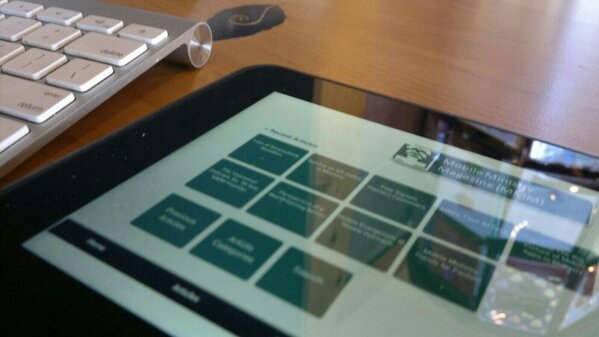
Mobile Minsitry Magazine al version loaded on Kindle Fire HD, via Twitter

Of the major news items to hit the internet in the past weeks, the shutting down of Google Reader seems to have hit many journalists, bloggers, and information gatherers pretty hard. Google Reader is a website by which you can collect website subscriptions and view them all in one place. Google Reader is based on a technology called RSS (developed by Dave Winer) that’s pretty much a core feature for many kinds of applications around the web (Facebook newsfeeds, Flipboard, etc. all use RSS or its technologies in whole or part).

With Google Reader shutting down though, its going to become a bit harder for some folks to keep up with those things happening in spaces they pay attention to. I’ve thought about this as it relates to mobile minsitry – which would be described by many as the long-tail of faith-based conversations, mobile, or technology new. Long-tail means that it happens at the edge, and there’s not a great maiinstream media component to it. Those whom are involved in keeping the subject handy are few, and therefore the audience is usually made up of people who go out to find the source, more than news driving them there.

Google Reader has been a key component towards following up on many news bits that make it here. But, I’ve started to take steps to ween myself from there as I look for a better solution that fits my multi-device lifestyle. Part of my solution has been to invent my own RSS reader. That’s something that’s going along well, but I clearly don’t have the coding chops to make Google Reader, so I’m working along the features that I want, and the features that I can build. Doing so had me thinking about the audience here, and what you all might do.

We have this property called MobMin.Info which is a portal page towards those things about mobile minsitry – and it could be updated to point to RSS feeds of the sites featured there, in addition to being more dynamic towards showing the latest articles from those featured sites. Having coded something similar to this on my personal site, I see where it could work, and where it could probably cause a problem for some folks.

And for MMM, we’ve got this HTML5-based, dynamic landing page that does similar. The only real issue there is that it only points to content here, and only to a snippet of the latest posts. It does hav e a working search feature though. That could be something.

Still, that’s solutions made for one person, not a movement. So, the question stands: “how do you keep up with mobile ministry topics?” And what could be done better if you have stopped doing so?

Perhaps there’s an answer out there that doesn’t look like anything proposed,, but gives us all something to look forward to as information and connectivity become even more embedded into how this space evolves.

FaithVilliage’s 10 Recommended Apps

mobile device in cradle, via FaithVilliage

While its rare that we do these lists, its something that comes up from time to time from our partners. The latest of these recomended apps listings comes from FaithVilliage, with many apps on here that we’ve not seen highlighted as often before (which is good). Here’s a snippet:

4. Postagram: iPhone / Android

There’s nothing spiritual about the free Postagram app, per se, but we love to send encouraging postcards to our friends through it. The way it works: You choose a picture from your camera roll, upload it to Postagram, add a message, and Postagram will create the postcard and mail it to the recipient for 99 cents. They’re just a fun way to tell someone you’re thinking about them, praying for them or for sending them a verse of encouragement.

5. OverDrive: iPhone / Android

This free app allows you to download books from your public, school, or college library. The cool part, though, is not that it’s an eReader, but it’s also an audio book reader. So if you’re on a road trip or commuting to work, you can find your library (over 18,000 libraries use OverDrive), check out a title (you need a valid library card first), and listen to it while you drive. While school libraries might not have Christian literature, public libraries often do. What’s even better: You don’t have to worry about returning the title. It expires at the end of the lending period.

Readof the rest of 10 Highly Recommended Mobile Apps for Christians at FaithVilliage

Disclaimer: MMM’s content is syndicated at FaithVilliage. They are a content partner.

Adaptive Interfaces

All Books on Nokia N8 screenshot

Many of the user interfaces that I come across on the various mobile devices that I interact with are not all that neat. Let me correct that. They were novel and neat when I first acquired the device or application. But, that quikcly got old and stale – especially in those applications that I interacted with the most. What would be neat in many of those cases is the interface adapting to my increased usage and then changing to either expose more of itself, or trimming to only exposing the features that I use the most.

I’ve taken to calling it adaptive intelligence or an adaptive interface. Basically that as I spend time in the application or program, that it adapts to my greater comfort with some features, and recommends or trims what I see based on what is learned about my usage. This was some of what when into my UI design for All Books – as you went into a book/chapter, the book name/chapter number would “age,” dimming itself compared to what you haven’t read as much. In time, you could see what areas of the Bible it was that you didn’t read much easier than you could get to the parts you did read more often.

I’m not the only one thinking along these lines, but I do think that its something that we can do a good bit more of in this space of faith-based content. It seems like a new UI idea, and even has been proposed as much in an article at FastCo Design:

…In 1975, the Hungarian psychology professor Mihaly Csikszentmihalyi outlined his theory of “flow” in his seminal work, Flow: The Psychology of Optimal Experience. He defined the concept as ‘‘the holistic experience that people feel when they act with total involvement.’’ When in the flow state, people become absorbed in their activity, narrowing their awareness to the activity itself, losing self-consciousness, and feeling in control of their environment. Flow is also proven to have a positive impact on learning. In skiing, novice practitioners are advised to spend the first few days at the green beginner slopes to get the best learning experience. On the other hand, experienced skiers will find themselves bored at the beginner slopes and must seek their optimal experience on the black expert slopes. This individual balance between skill and challenge is, according to Csikszentmihalyi, called the “flow zone” and staying in this flow zone is the best possible way to learn and make progress while still feeling constantly challenged and intrinsically motivated.

While flow has been extensively applied in studying a broad range of contexts, such as sports, shopping, rock climbing, dancing and others, I believe that, by drawing inspiration from video games, flow can be used to improve the user experience in interactive electronic consumer products…

It takes a lot of foresight to make an interface like this. Similar to the classic “choose your own adventure” books, the application author has to be content with designing many paths to a solution, and doing so in a way that doesn’t break up the story. What would a bible look like if it adapted to our reading tendencies? Or better, what about a Bible app that started off doing simple search and reading, then evolved to something like a full-blown study/sermon companion like Logos/Olive Tree’s products? Would be kind of neat IMO.

Thinking about Decay As Much As Create

Coda electric sedan coming off assembly line

Despite the frequency of posts slowing down a bit here, there’s still a lot of thinking and positining towrards this idea that mobile devices, services, and expereinces facilitate part of the lens by which we should look at faith in these times. In a most recent reading about steamboats, landlines, and cars, the challenge was not to think about it in terms of creating something new, but what it looks like when technologies and practices decay. Here’s a snippet:

…Some niches eventually grow to replace the prevailing regime, as cars themselves once did. But that process is equally dependent on so much more than technological invention. Look at how the cell phone has evolved to replace the landline. Our need for cell phones didn’t arise in a vacuum. Work practices changed. Commuting times got longer, creating the need for communication inside cars. Batteries got smaller. Cell phone towers proliferated.

These are the unnoticed events that happen in the slow course of technological transition. We didn’t even recognize that the car was a fundamentally new thing until around World War I, Cohen says. Until then, many people viewed the car as just a carriage without a horse.

“The replacement of the car is probably out there,” Cohen adds. “We just don’t fully recognize it yet.”

In fact, he predicts, it will probably come from China, which would make for an ironic comeuppance by history. The car was largely developed in America to fit the American landscape, with our wide-open spaces and brand-new communities. And then the car was awkwardly grafted onto other places, like dense, old European cities and developing countries. If the car’s replacement comes out of China, it will be designed to fit the particular needs and conditions of China, and then it will spread from there. The result probably won’t work as well in the U.S., Cohen says, in the same way that the car never worked as well in Florence as it did in Detroit…

What Steamships and Landlines Can Tell Us About the Decline of the Private Car at Atlantic Cities

In thinking about the implications of this tech, are we also paying attention to what decays in order for mobile to rise? And then futher, when mobile decays, what will arise from there?