Monthly Archives: January 2013

EBook Glue

ebook glue
Its been the case for a long time now that MMM has been around. We used to offer a downloadable magazine, but have since gotten away from it since we’ve basically leveraged the ability that you (the reader) have to subscribe via RSS, email, and other methods (we once had an SMS service too). One of our goals this year is to bend MMM away from the idea of a destination point, and allow you to embed MMM into your site or method of reading/resources in a fashion that fits you best. In seeing the service EBook Glue that just about gets us there.

Essentially with EBook Glue, you insert the RSS feed (ATOM, RSS, or just the URL if you don’t know the first two), and then add a title and you get an ebook in an ePub or Mobi file that you can install to a mobile device. I think of a situation where you can take that ebook and put it onto a sharing service for your community to download – for example a study guide, package of perodic announcements, or even a ministry guide. For an example of what EBook Glue can do, here’s MMM in ebook form: ePub | Mobi.

Makes sense for us to continue in this form. We’ll add this to the other links that we’ve already published on the About page. The book is yours now to create and open.

via LifeHacker

From Cellular to IP

VoIP on Symbian with Gizmo VoIP screenshot

Of the many reasons that I’ve had for wanting different mobile devices over the years, one of them was this idea that I could use the data connection of my mobile to be the voice (phone) line. Whether it would be through services such as Skype or other types of VoIP/XMPP services, I continue to see that the future of the phone line is a limited one – given what’s possible via the Internet.

I’m not the only one thinking like this. There are several folks who have gone towards similar lines of thinking with their mobile and tablet devics. For example, there’s a person who wrote recently of using the HSPA Google Nexus 7 as their only mobile device:

…Overall, I’m pretty happy with the using the Nexus 7 as my only mobile device experiment, and will probably stick with it for a while, at least until phone screen sizes start catching up…

Its not just people thinking like this, phone companies are as well. Ars Technica talks about AT&T’s pointing in this direction:

Two months ago, AT&T petitioned the Federal Communications Commission to plan for the retirement of traditional phone networks and transition to what AT&T sees as an inevitability: the all-IP telco.

AT&T had been discussing the transition internally, spurred on by the FCC’s own suggestion that the Public Switched Telephone Network might be ripe for death somewhere around 2018. “This telephone network we’ve grown up with is now an obsolete platform, or at least a rapidly obsolescing platform,” Hank Hultquist, VP of AT&T’s federal regulatory division, said today. “It will not be sustainable for the indefinite future. Nobody’s making this network technology anymore. It’s become more and more difficult to find spare parts for it. And it’s becoming more and more difficult to find trained technicians and engineers to work on it.”

And when you think about it (communication’s taking priority, mobile being a primary interface, etc.) these kinds of moves just make sense.

So, in paying attention to the trends – voice isn’t the primary interface for mobile amongst other items – how does your organization/ministry plan to meet people when the state of communications is hyperconnectivity by default?

Implications of Option B

Mobile phone on the table during a farmers meeting in Bwera, Uganda
Its been my experience that many who are coming around to this idea that mobile is pretty much it, find it hard to believe the place that communications takes over other physical and psychological needs. Then again, the research is out there, and it does make sense when you are able to break from your cultural norms and see what others value:

…He is trying to argue that the consequences of the 2nd Industrial Revolution, which bought to common people electricity and plumbing, was far more important than the computers and internet which the 3rd Industrial Revolution has brought us. (Gordon’s 1st Industrial revolution was steam and railroads.) As evidence of this claim he offers this hypothetical choice between option A and option B.

With option A you are allowed to keep 2002 electronic technology, including your Windows 98 laptop accessing Amazon, and you can keep running water and indoor toilets; but you can’t use anything invented since 2002. Option B is that you get everything invented in the past decade right up to Facebook, Twitter, and the iPad, but you have to give up running water and indoor toilets. You have to haul the water into your dwelling and carry out the waste. Even at 3am on a rainy night, your only toilet option is a wet and perhaps muddy walk to the outhouse. Which option do you choose?Gordon then goes on to say:

I have posed this imaginary choice to several audiences in speeches, and the usual reaction is a guffaw, a chuckle, because the preference for Option A is so obvious.But as I just recounted, Option A is not obvious at all.

The farmers in rural China have chosen cell phones and twitter over toilets and running water. To them, this is not a hypothetical choice at all, but a real one. and they have made their decision in massive numbers. Tens of millions, maybe hundreds of millions, if not billions of people in the rest of Asia, Africa and South America have chosen Option B. You can go to almost any African village to see this. And it is not because they are too poor to afford a toilet. As you can see from these farmers’ homes in Yunnan, they definitely could have at least built an outhouse if they found it valuable. (I know they don’t have a toilet because I’ve stayed in many of their homes.) But instead they found the intangible benefits of connection to be greater than the physical comforts of running water.

Most of the poor of the world don’t have such access to resources as these Yunnan farmers, but even in their poorer environment they still choose to use their meager cash to purchase the benefits of the 3rd revolution over the benefits of the 2nd revolution. Connection before plumbing. It is an almost universal choice.

This choice may seem difficult for someone who has little experience in the developing world, but in the places were most of the world lives we can plainly see that the fruits of the 3rd generation of automation are at least as, and perhaps more, valuable than some fruits of the 2nd wave of industrialization.

Read the rest of The Post-Productive Economy at The Technium

Someone told me when I started MMM and they realized that I did nearly everything on my mobile that I was taking an extreme stance on getting to know this space. I’d argue that such a posture isn’t extreme at all, but in fact bends towards understanding the implications of these choices better than simply counting an observation and marking its characteristics versus what my culture determines as normal.

Are These Your Design Trends

A site that I was reading recently (The Industry) noted 13 design trends for 2013. Are these some items that you are implementing ino your mobile applications and services:

  1. Flat Design
  2. Fewer Buttons/More Gestures
  3. Animation as Affordance
  4. Hamburger Menu Drawer
  5. Native over Web
  6. Responsive if not Native
  7. Wider Websites
  8. Larger Fonts
  9. Larger Search Inputs
  10. GIFs as Design Elements
  11. Designing for Humans
  12. New Colors
  13. Vector Graphics

Read the explainations and see examples of these at The Industry

As a side note, changes done here will reflect #1 more than any other, an probably #13 if we can pull of something the web isn’t doing normally. The rest of these don’t fit the context of this type of site. Unless a designer can convince us otherwise 😉

Bookless School

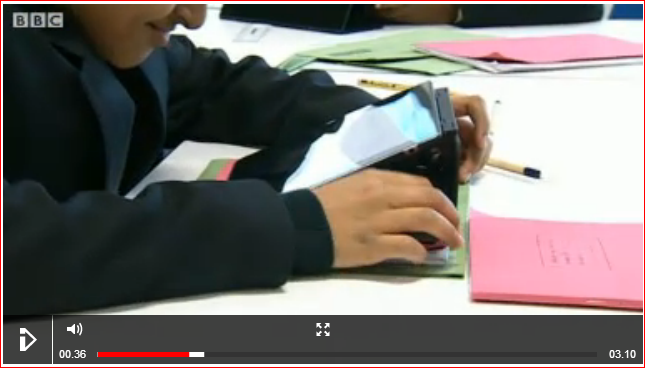
ESSA Bookless School (via BBC) - visit BBC to see video

A few years ago at the 2011 Mobile Ministry Forum Consultation, I embarked on an experiment where in talking about tablet computers in a mobile ministry perspective, that I performed the presentation strictly from my iPad – no projector, just the tablet. I again performed a presentation at the 2012 MMF Consultation to a greater degree of success, and with some interesting feedback. There’s an important implication we were trying to get over here, that there’s a difference to engaging content that can be done if we don’t rely on traditional methods of presentations or handing out print materials. Good thing we aren’t the only folks trying stuff like this, as witnessed in this BBC article:

A school in Bolton is pushing the boundaries of education by putting away pens and paper and giving all pupils and teachers their own iPad. The Essa Academy says it helps students and has cut costs, including reducing the school’s £80,000 photocopying bill to just £15,000 a year.

Sure, we don’t hear about how much the tech adds to the costs, nor if there’s any training and the compentencies of the kids, teachers, and admin for this school (which is usually the case in these stories). But, we do see possibility that in doing an event in a different frame, without the ropes of some of the past, that we do get something a little bit more introspective, immersive, or even rewarding.

The video on the BBC page was not embedable; we linked to the one on YouTube, so there’s a chance that it might be taken down at some point. The link to the original article at the BBC remains in this piece

Are You Born Mobile; CES’s Question

From our friends over at Mobile Industry Review comes probably the best reason to be at CES and any other tech conference this year – phrased in the form of a question and a perspective:

Chances are, you aren’t. But, you community has members who are. So what are you going to do to enable them to live a mobile-encouraged live that looks like the Gospel?

Answering Questions on Mobile Ministry Trends

A little while ago, we were asked by Cybermissions to answer some questions for an upcoming class on mobile and tech they are leading soon. We thought it good not only to answer the questions, but to also do something that could be useful for the MMM audience.

The video is about 13 and a half minutes, and just runs through some thoughts on mobile, mobile ministry, and things upcoming. Listen closely, you will probably find something worth commenting about 😉

Highlighting Partners; Support

Speaking a bit towards one of our resolutions for 2013, we’d like to highlight and partners that have joined with MMM over the past year, and later open the door for you or your organization to partner with us.

The last two years have certainly been heavy ones in terms of ministries becoming more aware of the power of text messaging (SMS) for communications, giving, and outreach. To that end, it was great for us to partner with Mobile Cause (@mobilecause). Mobile Cause is a company which has a focus towards Text-to-Give Services, and has their own mobile giving and fundraising platform that’s able to take nearly any kind of intention, and make it accessible by SMS giving. Stay tuned for some exceptional case studies from them being highlighted here, as well as possible offers towards engaging with Mobile Cause directly.

The other request that comes this way pretty often is to ask if we do any development. MMM sticks to journalism and strategy, and keeps project management and mobile development work highlighted in the hands of groups like IT Hands (@ithands). IT Hands is a full-circle IT services company – this means they design, implement, support, and maintain custom internet solutions for nearly any sized organization. Technology consulting, software development, internet marketing, mobile apps/services, and even print design falls under the specialties offered by IT Hands. We’ll also be having some case studies from them, and possibly some collaborative projects we’ll be able to talk about.

The latest partner that we connected with, and are very excited to see more work alongside, is Symbiota The Fluid Ministry. The Fluid Ministry is a one part an IT consulting firm, and another part a multi-layered communications platform for ministries who are looking to capitalize on mobile, website, branding, and social media activities. The Fluid Ministry has a platform (CrossMRKT) that we are still learning the bits and bolts towards, and offers several webinars monthly which point to areas of enablement, interest, and opportunity around their platform and service offerings. Look forward to those webinars being added to the Mobile Ministry Event Calendar, in addition to other shared events and projects between us upcoming.

Partnering with MMM

As you can tell, we’ve been deliberate in engaging with these partnerships. One of the goals for these partnerships is to bring light to some of the folks whom are working on not just the strategy and theology of mobile ministry, but are helping to make those ideas come to life. On our end, MMM offers over 7 years of experience and leadership in mobile ministry, and more than a 20 years of experience in web and mobile combined towards pushing these efforts forward. Its truly our hope that as a leading voice for what’s happening in mobile ministry, that you can be confident that if we are putting our name with the organization, that we’ve taken the time to pray and investigate why it makes sense to go that route.

That all said, we’ve got some notable gaps, and obvious opportunities. We’d love to partner with organizations who are doing multi-language projects (software, education, or media), cross-media producers/outlets, and even individuals who don’t just have interest in being heard in this space, but who have been able to carve out a niche of demonstrating definitive value for this type of audience. We keep a constant conversation with many groups, and not all might become recommended partners, but many do at least make it to some mention on our site.

Supporting MMM

The other side of partnership is simply supporting MMM. As you can tell, we’ve stayed away from adding ads to the site, and do our best to keep sponsored content from distracting from the purpose of this site to question, move, and experiment at the intersection of faith and mobile technology. However, this is a solo effort, and a good bit of time goes into not just making the content, but developing the relationships, maintaining mobile hardware (we are blessed to have someone who has donated a server and admin of a full WordPress install), and traveling to engagements that point to opportunities. Those things cost, and over the past two years of this being a full-time adventure, there are many items that have fallen off the plate simply because attention had to be taken off of MMM, and put onto keeping a roof over the head. If you would like to contribute financially, there’s a PayPal Donate button in the sidebar, and also on the About page.

Prayer is also appreciated as a means of support. I can’t tell you just how much its meant for many people over the years to just send a message that they’ve prayed for MMM and the work here. Its totally understood that MMM is groundbreaking work for many of you and you would love for God to not just continue things here, but with other groups such as the Mobile Ministry Forum. Prayer and encouragement are daily needs and I (personally) thank you in advance for keeping MMM and the entire mobile ministry effort in mind.

With that said, we’re getting back to the work of things here. Got some neat stuff coming, and many resolutions to hash out. Thanks for joining us at this intersection, and see you the next time the Light causes us to stop and take a look around.