Monthly Archives: December 2012

Reviewing Mobile Ministry in 2012 (Pt2)

Continuing with this look back into mobile ministry (#mobmin) for 2012, we will take a look in this piece at a few more of the resolutions that were made, our progress in them, and how that points to future happenings for MMM and the genre of mobile ministry.

Resolution #3: Get Connected to Tech, Mobile and Mobile Ministry Events
This was actually a very hard one to come through with consistently. We did have a good start of things though with the introduction of the Mobile Ministry Event Calendar back in April. I think that this by itself was quite helpful towards just helping folks wrap their heads around how many ways that mobile ministry can be infused into mobile and tech conversations. Beyond that, the conversations that started behind the scenes about having more specific content geared towards how mobiles are used in ministry were generated because of this. To that end, this part of 2012 was quite successful.

Where it wasn’t as successful came on the end of attendance to more events. Though it seems like a great policy to go to 8-12 events in a year, that can’t be all that MMM is exposed to if we are going to continue to be one of the more public faces for mobile ministry. A lot of that is directly due to the one-man-operation for much of MMM; it takes a lot to make a living, then save for getting to a lot of these conferences and events where many times even if MMM is asked to present, that there’s no compensation towards travel or an honorarum coming. I hope that in 2013 things change in that respect, but am making concessions towards doing those things that keep food on the table and possibly scaling back how much time is put into MMM.

There’s a lot left to be put onto the calendar for 2013. God’s got the calendar and what we will be at then.

Resolution #4: All Books Project and Raising the Bar on Mobile UX
One of the areas that attending a few events in 2012 did help was in meeting this resolution. MMM has spent a lot of time revisiting the UX (user experience) end of information design and knowledge management and one of the outputs from that was the All Books Project.

Since that start last Christmas, the All Books UI has come a long way. There’s a solid performing HTML5 and jQuery-driven shell. With some effort, its basically possible to put nearly any compiled collection of Bible books, that are in HTML format, into an archive that this user interface (UI) points to. Unfortunately, a data mishap earlier this year lost the excellent NET Bible with notes that helped spark this project. But, there are several collections able to take its place. A current project has us working on taking Phillip Pope’s Thai translation of the KJV and applying All Books to it. Neat stuff for that audience if the encodings hold.

Other pushes into changing, or at least expanding the approach that faith-themed applications and services that have happened this year include:

  • Paying more attention to non-smartphones, for example Phone Publish
  • Not just a want to, but a concerted effort for ministries to utilize mobile giving (definitely check out our ministry partner Mobile Cause for this kind of service approach)
  • Not just asking the question, but making non-application approaches to getting the Bible onto mobile devices, such as John Dyer and Digital Bible Society’s Bible Browser
  • and several more approaches

Yes, like we said yesterday, there’s still this challenge of getting people to think outside of the “is there an app for it” way of doing mobile. But, I think the ground is working well into that direction. What happens next for these interactions has to push the mobile more into its unique characteristics, something that I think AR and similar tech have a good chance of doing well.

Resolution #5: Become a Digital Faith Advocate
I can remember in talking over email with Tony Whittacker when this point came up. There can be no movement or expression of mobile in ministry that transforms anything if only a handful of people stand up for it. There has got to be a moment where people are encouraged not only to do mobile ministry, but advocate that its direction and approach are legitimate.

By default, MMM gets to sit into making this happen all of the time. In doing some neat things such as speaking in some local tech events in Charlotte, or getting interviewed again by the BBC, we’ve certainly made for a presence about this mobile ministry space. But, the best has come from others.

Chris White Ministries gave us an excellent look not only into why mobile ministry makes sense, but whom it makes sense for in one video. Renew Outreach connected with us earlier this year not only to talk about how they are seeing mobile at the edges of the earth, but the kind of tech challenges that sit in the deepest of areas. A guide to mobile ministry was published, and a mobile ministry training course added another needed entry point into this discussion. And I can’t forget the conversations with students at Taylor University, Central Piedmont Community College, Biola University, and on the webinar with Symbiota. These are the kinds of moments that not only share the passion we have, but give others a chance to jump in and express their’s as well at this intersection of faith and mobile tech.

So, What’s Ahead for 2013
Part of me doesn’t want to go into trying to answer this. We’ve been constantly evolving the ideaology that is mobile ministry. From a 1st crack at just helping pastors, to now having a stable of resports, guides, and a methodology to guide this discussion across several applications of mobile ministry. This is a big space, and I don’t see 2013 being a year where MMM will have to, or will be able to, continue to do this alone.

I do think that we are ready for another shift in mobile. Yes, there are several reasons for this (lots of Android devices, wearable computing, Microsoft shifting the desktop/laptop paradigm, services-as-needed, OTT, and more pervasive reasons for having web-something on a mobile). But, I think the bigger one is simple: its just time. Changes in mobile have happened in 5-6 year spurts. There’s always a company that comes out of a nearly quiet place and does something disruptive enough that it makes others stand on end. Jolla, Mozilla, Leap, Amazon, and even Google to some measure, can play this card. I think 2013 is where we see that disruption, and its probably not going to look comfortable for any who have been on the fence about mobile or mobile ministry.

For this year, we’ve had in our possession several Nokia devices (the N8, N950, Nuron, Lumia 900), the iPad and a Kindle Fire HD. Am looking forward to probably investing either in swapping out all of the mobiles for an N9 or whatever Jolla brings to the tablet (especially if its like the Asus Padfone), and probably phasing out the use of a tablet (!!!). Instead of a tablet I’d like to experiment with expressions of #mobmin using a smartwatch (something like the Motoactv). Somehow, I’d like to get in my hands a device that’s able to run the upcoming Firefox OS, and the N9 might get Jolla’s Sailfish OS. BB10 looks like it will be a great play as well, but I see it more on the outside peronally (we’ve got someone who will speak on that in 2013 and own one of those too). Of Android, iOS, and Windows Phone, they are mainstream enough that the reading audience will have plenty of opinion. We’ll get impressions, but nothing owned unless its given. And nope, we aren’t going to get on Facebook unless you share us there šŸ˜‰

From MMM’s end. I don’t know. This site could fold into nothing, or there could be a team supporting efforts (I would so like the latter). I don’t see the site as a destination existing beyond 2013… MMM would be much better if served like an API (you plug into our content what works best for you, and then whether its reading, searching, building, or selling, that you pull what can work best). That’s something that wouldn’t take as much work as it sounds like… though for many of you who come to us via a generic Google search (about 45% of those who come), this would be a major shift.

Or, other sites could just come and do a better job, and we could retire to being a college professor who does the occasional speaking engagement šŸ˜‰

Mobile is the present, not the future. For 2013 and beyond, make it into your magic wand and do something to elevate Christ into someone’s world.

Reviewing Mobile Ministry in 2012 (Pt1)

Its been a good, hard, long, joyous, and trying 2012 for so many people. Given that we’ve been good at looking at a few set items, let’s take a look at a few of these and see how we’ve kept to those resolutions, and what that means for MMM and mobile ministry (#mobmin) going forward.

Resolution #1: An app is not a strategy
It sounds like a statement more than a resolution, but given the impulse that many have had towards mobile, its a resolve more than anything else. Many of those coming up to speed with mobile, either through acquiring a mobile device or being astounded at the number of mobile worldwide really have had a challenge of where to start with mobile. Unfortunately, that start has been with the perspective of smartphones and applications. Which is good in part, but so small towards the rest of the picture of mobile, that we made this stance with the hope of helping folks know the entire picture of mobile/mobile ministry.

Were we successful? Possibly. At the same time, such a stance is something that gets proved over time. Which is what we hoped with many of this year’s presentations. It was only the first one, perhaps the other resolutions better prove or disown us from such positions.

Resolution #2: Specifically Define Mobile in Education
We started off this year at making a point to not just define what mobile ministry looks like, but make sure that the focus wasn’t just on the technology, but on how its used to engage, empower, and transform people/communities. Essentially, what does mobile ministry look like when the context is education (and to some extent, discipleship).

I think we’ve got a bit of a road ahead of us, and not just MMM but all who do mobile ministry, in making that point clear. Yes, its clear that there are some advancing processes and lessons in mobile ministry developing, but how these are influencing, changing, and even challenging educational constructs is still unclear and not well defined. We’ll see movement on this front in 2013 with the lessons learned from initiatives like the Mobile Ministry Course and others to be announced in the coming months.

Concerning these two areas, what has mobile ministry opened, closed, revealed, or challenged for you in 2012? Does it matter that the visibility of this space has grown such that these count? Or, is there something more to be done and uncovered?

That’s just two of five. Stay tuned as we look to point out what we’ve done with the other 2012 resolutions in the next article.

Merry Christmas from MMM

Palm Treo 680 and Wireless Keyboard at Starbucks Annapolis

From all of those who’ve contributed to keeping Mobile Ministry Magazine (MMM) going for the past year, we just want to say thank you and Merry Christmas to you all. Its been a hard year in many respects, but, we are still seeing God come through in so many ways. Thank you for your reading, sharing, pinning, and attention.

Mobile Stats for EoY 2012

Mobile Stats for EoY 2012
Global
Population Subs Pen. Rate Uniques New Subs Dead/Not-Active
7.1B 6.7B 94% 4.3B 700M ???
Devices
Handsets Feature Phones Smartphones New Devices Second-Hand SIM-Only
5.3B 4B 1.3B ??? ??? 1.4B
Communications
SMS MMS Premium SMS Voice Social Net. VoIP
5.6B 2.9B 1.9B 5.4B 1.1B ???
Features
3G WiFi Camera Browser/WAP Browser/HTML GPS
1.3B 1.1B 4.8B 2.1B 1.5B ???
Apps & Services
News Apps Gamers Search Ringback Tones Ad Audience
2.3B 1.2B 1.2B 1.3B 1.0B 4.0B
Other Tech
Tablets PCs TVs Newspaper Digital Cameras Port. Gaming Devices
??? 1.6B 2B 430M 300M 250M
Source: Tomi Ahonen Almanac 2013 and Communities Dominate Brands
Shaded blocks are added columns by Antoine RJ Wright, which may not be answered in source data or other readily attainable sources.

Apologies for how tight this is if you are viewing this in a browser on the site; the template didn’t take to this table so nicely on all the pages. Click here to just view the table.

Glorystone.TV and Shifting Mobile Video Habits

One of the things that marketers, advertisers, and content producers are beginning to come to grips with in viewing mobile is that not everything that happens on these devices happens when people are in motion. It happens on a mobile device, just not in motion. More often than not, the attention required by what’s happening on the screen puts people in stationary states, and therefore what becomes mobile isn’t the device or the person watching it, but the channel or the content has its being shared from one person or entity to another. From that viewpoint, it makes it seem as if mobile is nothing more than a portable, on-demand TV – and if you were to take the approach that many have taken so far in terms of being a content provider, that’s pretty much all mobile is to them.

But, what if mobile and broadcast media took more advantage of not only a state of mobility (the device, the context, etc.), but also the needs of the marketers, advertisers, and existing media producers that have audiences, but not necessarily the digital savvy to make it work great. Could it look something like this:

Glorystone.TV is a different, and in my opinion better take, on the idea of a media platform. Essentially, its a platform of tools and services that enables consumers to find relevant Christian media, marketers to understand and target markets with the best product, and content producers to better find and reach areas of opportunity for their content. All in all, its not like much else out there.

With research coming out saying that over 60% of folks who view videos on their mobile/tablet devices, do so when at home, you’ve got something of an opportunity if you are in the space of creating content. And at the same time, traditional models of broadcasting don’t do a decent job of helping you better target and understand your audience. If this sounds like something you/your ministry could get involved with, get in touch with Glorystone.TV and see what a realized digital solution looks like.

Disclaimer: Antoine is one of the members of Glorystone.TV’s advisory board.

Remember the Purpose

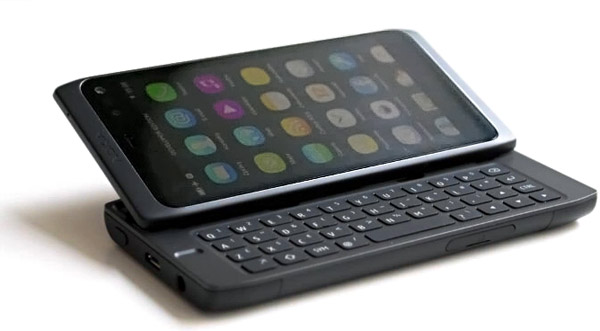
Some weeks ago, probably a month ago now, I made a phone trade with a friend of mine. In the trade, I acquired the not-for-sale Nokia N950. I’ve been wanting to get an extended play with this device for sometime. Besides the user interface experience being like nothing else (except the for-sale N9 that’s hard to get my hands on as well), there are no other mobile devices out there with theĀ pedigreeĀ of a Nokia and the openness of a full Linux distro (Maemo/MeeGo) under the hood. For a tinker-er like me, this is just like letting me loose in a candy story, when my teeth are coming in.

During this time, I’ve been going back and forth between the N950 and my N8. Back and forth between MeeGo and Symbian. Learning a bit of what Nokia understood, and a bit more of what some developers/service providers have felt. There’s been something of an enjoyment when it came to setting up multiple Google accounts (without needing Exchange ActiveSync to get my calendars), Dropbox, Evernote, and several other services. There’s been some mild frustrations as in when I unintentionally duplicated the contacts on both devices because I made edits on both and it didn’t reconcile properly. And there’s been some joy moments like in finding a drawing app that felt a lot like when I used Adobe Ideas on the iPad (simple, zooming, and easy to push wherever). Its been enlightening, and aside from the old battery, useful.

That said, the other night, when I should have been getting some sleep before a few meetings the next day, I was captured into reading Chasing the Cicada over at Metal Floss. It reads like a spy/crime novel, but is mainly about the depths of the Internet that we usually don’t see. Per my usual when a rabbit hole like that reveals itself, I start searching out things that stuck out in the article, one of which being the Tor Project. I’d forgotten about the Tor Project. At one point I was even looking at the Android port of aspects of the Tor Project called Orbot (really, if you use Android, this is a no-brainer direction you should take your platform usage). It then hit me to connect with some friends and rekindle the conversation about the N950 and making something useful out of this “dead platform” for a few ministry efforts.

It was at that point that I remembered why I had the N950 to begin with.

You see, I’d wanted the N950 not for myself, but because it would position my use of mobile into a few directed areas:

  • 1st, I’d be using a platform that would be getting attention for a specific mobile ministry project (or two)
  • 2nd, I’d be working with others who not only knew the platform better, but could expand my knowledge of specific mobile ministry applications that don’t usually get the light of day
  • 3rd, there would again be this experimental aspect to MMM – that kind of thing excites me and keeps me going in this space when times like the holidays roll around and everything slows down

In a real sense, I had to re-own the fact that to have the N950 in my possession could not be about my enjoying a new platform or having a new phone to play with, but it was to reignite the reasons why MMM is directed the way that it is – to ask questions, present approaches, and experiment around those ideas and activities that happen at the intersection of faith and mobile technology. Nothing about keeping this mobile in my hands, double-tapping the screen just to wake it up, pushed that purpose forward. If its in my hand, it has to be pushing this faith forward, and I already had the opportunity, I just needed to be kicked in the pants.

We sometimes get lost in the course of getting something new, or finding out that what we have in our hands is a lot more impressive than we thought. That same night that I realized this, I talked to a guy who had the new Google Nexus 4 for just about a week, but uses it no differently than a feature phone. I asked him of all of the unique features of the Nexus 4 and how he planned on using them and his reply was more like “I didn’t plan on doing that” rather than “let me explore how that feature could enhance how I view and do mobile.” To his credit, he also did remark that he’d not considered mobile on the kind of level towards the questions that I asked either. I know that I think a bit deeper about these things than some other folks.

Still, mobile is a very present avenue for all of us to take note as to the mission that we have in front of us. For some, the mobile is a siren call towards the kinds of security that you must keep up for those whom you are connected to. For some, mobile is a call to accountability in media, as well as relationships. And for others still, mobile is a beacon that there’s potential for something more than just reaching out and touching someone – even if all we needed to do at all is just touch them I get it. And I hope that you do as well.

So the kick happened. And I’m waiting to hear from a few folks who have a similar idea about the N950 and a few directions that we can take things. I remember the reason that I’ve got this device in hand. And I hope that you remember the reason why you have one in yours. Remember the purpose… then walk in it.

[App Request] Mien/Yao Bible

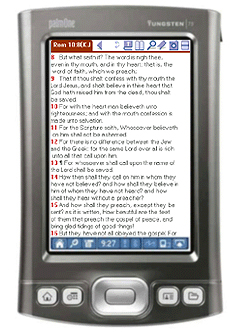
Image: Palm Tungsten T5 showing Palm Bible+

It has been a while since getting a request here for the availability of a Bible in a specific language or on a specific mobile platform (I think the last one was Telugu for feature phones), but that’s just the thing that happened a week ago. A reader who had combed through the listings on our Bible Apps page didn’t find what they were looking for, and asked if we could help in finding (or lead to the development of) a Mien/Yao Bible.

Unfortunately, the two sites that the requester pointed us to in terms of resources (Site 1, Site 2) have some issues either with their content sources, or with the character encodings. This isn’t an unfamiliar issue when it comes to mobile-friendly biblical data sources.

The other issue that presents itself with this request the the platform choice. As we’ve talked about before, its not about the sales that you pay attention to when it comes to mobiles, but what it is that people have in their hands. The two largest owned mobile platforms (at least from a smartphone perspective) are Android and Symbian. Its for these two platforms that a Mien/Yao Bible is being asked for.

So here’s the request (and possibly the challenge): to those of you whom are developers looking to scratch and itch or sharpen your skills, the Mien/Yao audience need a Bible for Android and Symbian devices. Are you up for it? Or, if you are a content provider, and have already started making available content for the Mien/Yao audience, would you be willing to make it available offline and in the .SIS/.SISX and .APK formats for this audience?

Get in touch with us and we’ll help coordinate the efforts in making this happen.

TEDx Video: Why Kenyans Do It Better

This was forwarded to us and asked if it is an example of who and how people and groups associated with mobile ministry (#mobmin) should approach the context of their activities. Much like Alex Oswald, there is a surprise to some at the level (and simplicity) of how mobile is being used in daily affairs.

A (Small) Critique
Despite what’s talked about on the video, an acknowledgment solutions that are obvious and should be applied in better economies, nothing much is being said about the strategies that went creating and implementing them. Solutions like these talk very much towards being associated towards mobile as living with people, not just pushing a platform or a message. Unfortunately, there’s too much of a reluctance, even with those of us who work within this mobile ministry space, to be so invested into using the technology/communications, that we can see where this makes sense in our spheres. In an observed sense, people want to develop towards the mobile audience, but not be the mobile audience they are developing for. We see after another’s implementation that its obvious, but don’t live with it close enough to discover our own.

For as long as this person was in mobile, to be surprised at M-Pesa said a lot about a general blindness to the Mobile past than about opportunities not seen. 10 yrs ago there were 1 billion mobile phone users, we were looking at the second generation of smartphones from Nokia, Palm, and a few others, seeing the fall of the PDA genre coming to pass, and some of the first positive steps in mobile web areas. Weird to me that he was surprised if that’s when he started.

Still, this is good for the mobile ministry space as many haven’t heard about what he’s seen, or might be working on similar and need the encouragement. When in and around mobile, you’ve got to keep your eyes open not just to what you want to see, but also what others have seen.

The Pressure of Immediacy; A Smarter Smartphone

Yoda Phone, via Engadget

If there’s anything that mobile has revealed, its that we all enjoy getting information and being involved with something or someone at the point of thought. Perhaps part of that speaks to a stroking of our ego (if the message is coming near me, then I am important and valued enough to receive it). But, we also end up walking this line where at some point that all of these streams don’t just consume us, but change us in ways that we’d not figured before.

Two articles in the past week speak to this change, and the challenge that we all end up having at some point because of the persuasivness of mobile. The first worth taking into your contempletive moments comes from James Whately – The Pressure of Immediacy:

…These two notes are what, to my mind at least, drive the ill-perceived pressure of immediacy. As in, just because we can look up just about anything on the glass screens in our pockets doesn’t necessarily mean that we should. The pressure to know something immediately is balderdash. It is fallacy, claptrap, and poppycock. It is a make-believe blanket of self-made suffocation that we have placed upon our own social and professional situations that really has no need to exist at all…

The second comes from Brian Feld – My Smartphone Is No Longer Working for Me:

I spent two weeks without my iPhone. I was completely off the grid for the first week but then spent the second week online, on my MacBook Air and Kindle, but no iPhone. I got home on Sunday and have had my iPhone turned on the past few days. I’ve used it as a phone, but I’ve largely stayed off of the web, email, and twitter with it. Instead, I’m only done this when I’m in front of my computer. I played around a little with the new Gmail iPhone app (which I like) but I’ve been limiting my email to ā€œintentional timeā€ – early in the morning, late at night, and when I have catch up time in between things…

In both of these pieces you see a resetting of expectations towards mobile and connected technologies. These are the kinds of things that should and shouldn’t have to happen though. I don’t think one needs a period of fasting from social networks in order to maintain a healthy perspective of them – I think that the engagement towards social media starts before you even get onto the service with the question “what kind of time/value will I assign to these kinds of connections, and is it worth what I’m assigning to it?”

I do think that we need smarter settings and tools within mobile devices in order to better utilize the attention spans we do have. I’ve spoken before about using Situations and similar apps on my Nokia N8 to turn the mobile off, ignore calls w/a friendly auto-message, etc. so that I can concentrate my eyes and ears on who/what’s near me, rather than what’s on the screen. Similar applications are available for Android and Blackberry devices (I’ve not seen similar for Windows Phone; to do apps like this on iOS you need to jailbreak your device). I also believe that at the network level, more intelligence needs to be added into services so that smarter actions can happen. I once wrote on what this could look like, and still wait for something like it to show up – but not be tied to a provider when it does (Google Now does something like this).

At the end of the day, what we do with this technology speaks to our value judgments. If we value time on the screen, that’s where we’d spend the time. If we value time face-to-face, then that’s where we spend our time. As ministries also walk this line into creating applications and services that make sense in the context of using mobile, we also have the responsibility that we are not designing away the ability for people to make intelligent and life-giving decisions about how this tech is being used. True, there’s something immediate about getting to someone your content that has a note of the saving grace of God; but its also important that they rely on God once they’ve gotten that message, not the beep of your application, calling them to a screen that they might not be strong enough to turn away from.

[Interview] Social Media Church, episode 26

A few weeks back, DJ Chuang of Social Media Church got in contact with us wanting for an interview for their weekly podcast on church and tech. That interview has gone live as of a few days ago. It goes about 30min, and you’ll hear a lot more about how MMM got started, what keeps it going, and some areas that this magazine will continue to push into.

Social Media Church, Episode 26 – Interview w/Antoine from Mobile Ministry Magazine