Monthly Archives: June 2012

Copyright, Licesning, and Faith-Based Resources

screenshot of the World English Bible copyright and liscense agreement
The publicaion, use, and sharing of religious resources has been a rights issue for as far back as there has been a faith practice to transfer. One can make the call that God even enforced the first rights-management system when he declared that “I am ther Lord your God and you shall have no other gods before me. (Exodus 20:2)” Weighty in the respect of reverence, but also in the respect of exclusivity – if there is to be a faith towards a deity, then let your faith towards this one be exculsive and binding.

To that end, the faith world has seen all kinds of challenges to doctrine, dogma, and behavior. Going digital has rekindled some old arguments and founded some new ones. In 2009, we tried to add some sense to the challenge and change that digital contexts makes in regards to copyright/licesning biblical resources. It was one part of an on-going discussion, and one where there just isn’t a clear answer. Its been an intention to add to that article some items of relevance – with a ground literally shifting often. But thankfully, others are picking up the discussion, and the mounting challenges not so much for just having access, but having access that fits the context of digital use and ownership paradigms.

The licenses that govern the use of modern versions of the Bible in English grant very limited, arbitrary permissions for the use of the content. For instance, a person may be permitted to use 250 verses of the Bible (or 500 or 1,000, depending on the publisher) but only if they do not include a complete book of the Bible in their content. The amount of Biblical text they use is usually not allowed to exceed a certain percentage (often 25%, sometimes 50%) of the complete work. The table below lists current (at the time of writing) license restrictions on some common versions of the Bible in modern English. Note that “Max. Verses” refers to the maximum number of verses that may be used, “% of Total” refers to the maximum percentage of the text in the resource that may be Biblical text, and “Complete Book?” refers to whether or not a complete book of the Bible may be used in the resource.2

Version Max. Verses % of Total Complete Book?
CEB3 500 <25% No
ESV4 1,000 <50% No
HCSB5 250 <25% No
NASB6 500 <25% No
NET7 not specified <50% No
NIV8 500 <25% No
NKJV9 1,000 <50% No

Most licenses (though I am not aware of any exceptions) do not explicitly allow freedom beyond these specific permissions, meaning the restriction preventing the translation of the Biblical text has not been lifted. For use of the text that requires more than this—like including the complete text of a book of the Bible—the user must enter into a specific licensing agreement with the copyright holder of the Bible translation. These licensing agreements typically include the negotiations of royalties from the sale of the content back to the owner of the Bible translation.

Read the rest of The Urgent Need for An Open Liscensed Bible in English at Distant Shores Media

Besides being an updated guide, towards the current challenges publishers, participants, and readers have towards digital faith-based resources, it also speaks to the problem of why there is even a greater challenge to create non-English faith resources. Simply put, law and process hasn’t kept pace with technology and behavior.

…Imagine a Christian pastor in Tehran who uses his mobile phone Bible application to search for what the Bible says about “suffering for Christ.” The pastor does not know that the free Bible he is reading on his app is only free in exchange for data about how he uses it. In fact, he cannot even do a search for “suffering” on his phone without a network connection, because his free app with the “free of charge” Bible he is reading phones home to the web service with every search he makes. And when his app phones home to an American website (a Bible website, no less), it may well trip a filter in the Great Iranian Firewall. And maybe around 2am, the pastor gets to find out firsthand what it means to suffer for Christ. Because his app phoned home. Because “free of charge” comes with a tradeoff, when it is not also accompanied by “legal freedom” at the level of content…

While I do think that in some revolutionary ways this will be addressed in my lifetime, I am also very aware that the nature of faith, data, and information lends itself to be something held close and valued towards exclusion rather than shared towards posterity. Hopefully, there can not only be a change that works for all here, but one that compensates rightly all the levels of engagement that it takes to make these resources possible to the global faith community.

Then again, is not part of the definition of religion that of a system that’s exclusive not just in application, but in information shared?
Carnival of the Mobilists 273 at Tego Interactive

Always a delight seeing the weekly Carnival of the Mobilists, a collection of mobile-focused writings around the web usually including insight, interviews, and perspectives that sometimes are missed in more mainstream conversations. This week, the 273rd CoM is being hosted at Tego Interactive, and probably is a bit more the mosaic of mobile than in times past. Having already dug into a few of these, I can say that you will definitely be challenged to think more holistically about mobile, and perhaps add your perspective to the voices.

Check out the Carnival of the Mobilists at Tego Interactive.

Guide to Producing Video on/for Mobile at Mobile Advance

Parlaying their learning of video production and mobile media, Mobile Advance has recently published a comprehensive guide to video production to and for mobile devices that should find its way onto your bookmarks if this is where your interests in mobile lie.

This is a researched and vetted pointer to existing resources, and so some of it might be deeper in some sections more than others. Nevertheless, if you are producing content for mobile, or looking trying to figure out why your media projects towards mobile and mobile ministry might have failed, this is probably one of the better resources you can grab.

What Future Does Digital Ministry Pursue

A few days ago, I was poked towards an excellent long read in an article titled Of Flying Cars and the Declining Rate of Profit. Of note, besides being recommended because of it being an excellent piece of writing, there was also a tug at the heart wondering what, if any, are the prospects of digital ministry endeavors when the core of much of why we are digital has such a fleeting impact? If you will, can digital ministry reinvent models of theology and culture of thevery model of tech is nothing more than a trade of simulations?

Here’s a snippet:

…Where, in short, are the flying cars? Where are the force fields, tractor beams, teleportation pods, antigravity sleds, tricorders, immortality drugs, colonies on Mars, and all the other technological wonders any child growing up in the mid-to-late twentieth century assumed would exist by now? Even those inventions that seemed ready to emerge—like cloning or cryogenics—ended up betraying their lofty promises. What happened to them?

We are well informed of the wonders of computers, as if this is some sort of unanticipated compensation, but, in fact, we haven’t moved even computing to the point of progress that people in the fifties expected we’d have reached by now. We don’t have computers we can have an interesting conversation with, or robots that can walk our dogs or take our clothes to the Laundromat….

Read the rest of Of Flying Cars and the Decline Rate of Profit at The Baffler; then be sure to contribute to their Kickstarter campaign

When pulled through a theological lens, we can ask things like “where is my icon that allows me a conversation with Peter or Paul?” Or, that interaction that gets Stephen (the martyr) and Martin Luther in the same room with Polycarp mediating the debate? There’s a lot about this faith that this tech should have been more than able to provoke past imaginations, past the norm of the institution. But, it has been somehow curtailed from its place, much in the same way the author of The Baffler’s piece says that many of us have been intellectually, spiritually, and culturally.

What future do you plan for if you do this digital ministry? Does it matter to you if you create the future, or if you are driven by another’s mishandling of it?

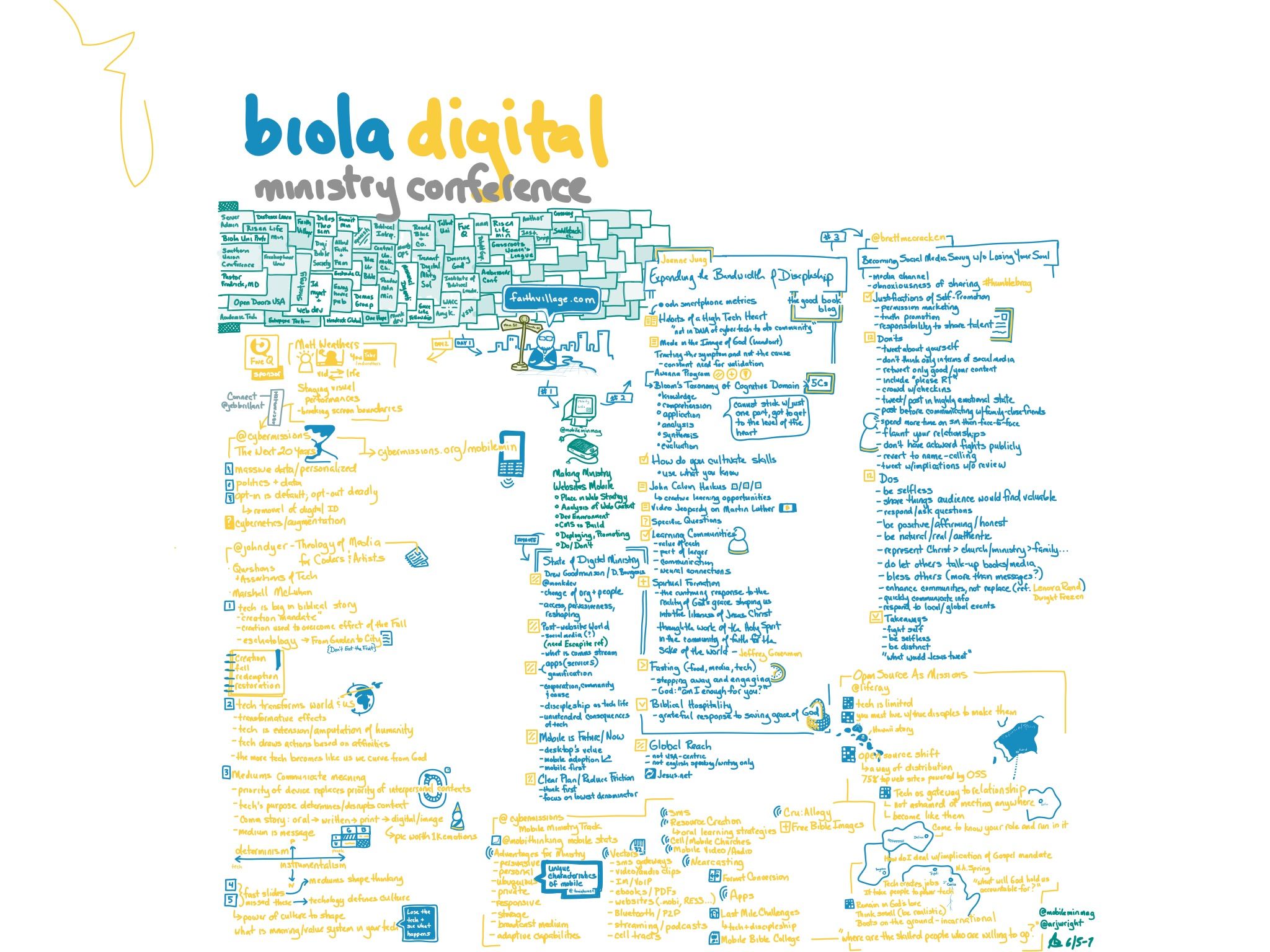
Biola Digital Conference 2012 Sketchnote

There was a point during the Biola Digital Ministry Conference where it was put out there and became a calling card of sorts that I was sketching my way through the sessions I attended. That made it all the more important to get this up and done. It is a very small slice of what I’m finding in back-channel talks was a very wide and deep connect for all of us who attended. This is definitely something you’d want to put on your radar for next year.

Biola Digital Minsitry Conference 2012 Sketchnote by Antoine RJ Wright
(Click on image to view full-size PDF)

Introduction to Mobile Ministry by Cybermissions

For some of you looking to learn more about mobile ministry so that you skillfully apply some of the approaches and perspectives put forth here, you might want to look into enrolling into the Mobile Ministry Training Course offered by Cybermissions. This 4-week course is designed to introduce you to the uses of mobile technology platforms for Christian ministry. Here’s what the four weeks of courses look like:

Week 1: Overview
Theory: Overview of Mobile Ministry & Its Potential
Practical: Student is introduced to the various main types of mobile phones, and mobile delivery platforms, and their potential for sharing the gospel in various nations.

Week 2: Evangelism
Theory: Mobile Evangelism and Follow-Up
Practice: SMS gateways, use of “text”, mobile messaging, bible apps, evangelistic uses, blended uses e.g using mobile to follow-up after a crusade evangelism event.

Week 3: Training & Discipleship (Low Bandwidth)
Theory: Oral Learners, Storying and Mobile, Reaching The Last The Least and the Lost
Practice: Audio & Video for Mobiles, parameters, file conversion, creating audio and video content, repositories, how to upload, how to distribute audio & video content and how to use these technologies in training situations.

Week 4: Training & Discipleship (High Bandwidth)
Theory: Various kinds of apps and operating systems and application development frameworks, constraints for small .Mobi websites, learn about tablets, e-readers and format conversion software
Practice: Create an Android app and a small .Mobi website to host it. Learn how to convert some content for e-readers.

With that kind of schedule, it makes for a comprehensive and fuller understanding of mobile ministry and it’s various spokes.

For more information, including course pricing and schedule, visit the Cybermissions Mobile Ministry Training Course website.

Layar Creator – Adding Interactivity to Print

One of the complaints that I have with church bulletins is that they are passive. There’s just text, maybe a few pieces of off-centered clip art, and more text. Its to the point that I can only get impressed when I see that a church has actually used a quality stock of paper and ink. And of course, those bulletins don’t last in my possession very long. I snap a picture of what’s important, and hope to be able to hand back to a member/usher/greeter the item so they can give it to someone who might keep it. That sounds horrible to some, but if Layar has anything to say about it, things just might change for the better for print bulletins and other static media efforts.

Some days ago, I read (at Engadget, Reuters) that Layar Creator is now available as an web-based augmented reality (AR) media enhancement platform. It works very simply, after creating an account, you upload a PDF, PNG, or JPG of a page or screen element (think: business card, letter, flyer, etc.), and then append to it a button, URL, or social media connector. Then save and that’s it. After that, when a person looks at that print media item with the Layar browser, they are able to see the digital content that you’ve “embedded” into that print page.

When seeing this, I immediately though of the QR-enabled business card that I’d been using until recently. To be able to do something additional such as add a AR snippet of the MMM Twitter feed, or an embedded YouTube video of one of our presentations would not just add to the information that a simple business card carries, but also endears people who interact with MMM to think in these mixed reality/mixed media intersections.

The second thought that came to mind was that of Bibles. I’ve many times said that if a mobile could be turned into a magnifying glass, that a print Bible would find renewed interest. Using Layar, a person could create an AR layer of their own notes on top of a print bible they own. Or, a publisher could encode pages or passages of a print Bible with videos, maps, commentaries, or even links to conversations happening around a part of the text (a modern day Tallmud). In this light, its more than simply having a QR code on each page that points to the content, but you don’t have anything at all, just the marker of the Layar icon on the page, or on the cover of the book noting that each page has augmented features.

This is the kind of engagement that mobile devices can open. And as soon as I get in front of a browser that’s able to do Layar Creator, I plan on adding this layer to as many relevant moments as possible. I’d recommend that you and your ministry seek to do the same; especially since Layar Creator is free only until August 1 (then its the normal costs for publishing layers). This could be some reality-redefining stuff. Visit the Layar website learn more and start your AR campaigns with Layar Creator.

This entry was posted in Uncategorized on by .

Scripture Earth

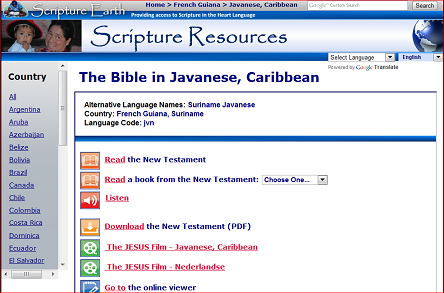
Scripture Earth screenshotScripture Earth is a web portal for text, video, and audio Bible resources in many languages, specifically having a unique listing of resources in non-trade languages which are many times harder to come by. Resources are sorted first by country, then by language. After clicking on the language, a page noting the available content for that language is displayed.

Most of the resources on Scripture Earth are best compatible with feature phones and older smartphones (PalmOS, Windows Mobile, older BlackBerry, etc.). Many of these files are in ZIP archives, so you either need a mobile which has a built-in unzipping application (for example, Nokia Symbian devices have this feature), or download an application to do this (for BlackBerry, Android, and PalmOS devices), or unzip on a laptop/desktop, then transfer the files by connecting a memory card or the mobile device via cable to the larger computer. It is best to follow the methodology of the mobile device when placing these files on the memory card/device (for example, music files into the Audio or Sounds folder; videos into the Video or DCIM folder, images into the Images or DCIM folder).

For more information, and to begin downloading these freely-provided resources to your mobile devices, visit Scripture Earth. View other resources, applications, and device downloads on our Bible and Religious Apps page.

This entry was posted in Uncategorized on by .

In What Language Does Your Mobile App Speak

Some time back, we pointed to the problem of finding non-English resources for mobile religious content. Its indeed a major issue, and later this week we’ll point to one portal page addressing it. But to give you an idea of what the scope of non-English actually looks like, check out this Top 10 video recently posted at MSN Video speaking of the top 10 languages spoken (primary and secondary) in the world.

In light of that video (or even the graphic on this post), what languages are your mobile apps, services, or ministry efforts prepared to speak?

This entry was posted in Uncategorized on by .