End of June Resolution Check

2012 calendar from Just CalendarCan you believe that we are six months into 2012 already? Wow. Taking a look back, we published six articles corresponding to five mobile ministry-related resolutions. Its been a lot of time since then.

Here are the items we posted:

  1. An App is Not A Strategy
  2. Specifically Define Mobile in Education
  3. Get Connected to Tech, Mobile, and Mobile Ministry Events
  4. All Books Project and Mobile UX Standards and Raising the Bar on Mobile UX Standards
  5. Become a Digital Faith Advocate

How are you doing in terms of following through or making goals to your resolutions?

Faithlife Digital Study Bible and Directions for Digital-Led Studies

faithlife bible, from logos
A little more than a week ago, the folks at Logos introduced a new digital-first study bible, app, and service called FaithLife Bible. Here’s a bit about it (pulled from the website):

With the FSB, you’ll get a multitude of Bible study resources on your computer or mobile device.

  • 3 layers of study notesLexham English BibleDevotionals
  • 1,400,000+ words—more than any other study BibleLexham Bible Dictionary (2,700+ articles)
  • About 400 photos, videos, and infographics

Use the FSB app anywhere.

  • iPhone &apm; iPad, Android Phones & Tablets, Mac & PC
  • Biblia.com, Logos Bible Software, Vyrso eBooks

The FSB is perfect for groups. The FSB ties into the Faithlife community, giving you plenty of ways to dig deeper together.

  • Create and join church, school, or personal groups.
  • Make and share Community Notes in the FSB.
  • Set group reading plans with reminders.
  • Share lessons, outlines, and other documents.
  • Set your own Faithlife privacy preferences.

FaithLife looks like something that makes a lot of sense, espeically to those people and communities which already have an investment into the (very large) Logos library of content. But, I think that FaithLife points at something worth considering a bit more (especially from the perspective of churches and publishers).

The Digital-Led Community
Something that we’ve seen with services such as Instagram is this idea of a digital expereince that’s not led first with going to an applicaiton or website, and centering your experience there, but in the midst of whatever you are capturing (this is key) that you share-from that experience to a community that connects with you. In a sense, you take the center of the experience from the tech and put it back on the experinece of living being shared.

When it comes to faith and life, there is a constant refrain that its not what you do at the faith gathering that makes what you believe valid, but how you live out life “in between the Sundays.” If you will, what you do that maginfies what you believe isn’t because you sing, dance, swoon, and legislate in unison, but because that activity led to a theology of life that was literally lived out.

Instagram is the kind of mobile application that leads to a heads-up affair for living. In order for you to have something of value for those following you on Instagram (or other social networks you publish those pics to), you have to have eyes and ears up noticing what’s going on around you. I look at Faithlife, Faith Village, and other religious websites/mobile apps/services and ask the question about being heads-up. Are you using these digital-led experiences as a means to stay aware to the life going on around you? Or, is this digital frame its own community, isolated from the needs of the world around you (James 1:19-21).

A friend asked me recently, “what Scriptures are you digging in?” He and I have been back and forth for 4 years studying the text and Judeao-Christian history together, its a normal question. I responded, “none; I’m building a Bible.” His response after that was awesome, “how is what you are doing adding value to the Body of Christ?” That’s the end of these digital endeavors, and where all of our communities and efforts need to point. If we aren’t adding value (John 17:20-26 is one metric), then we are not living aware of the needs of the world around us, and pretty much just making items that are a waste of the time that all of us need to enjoy life with Emmaunel while here.

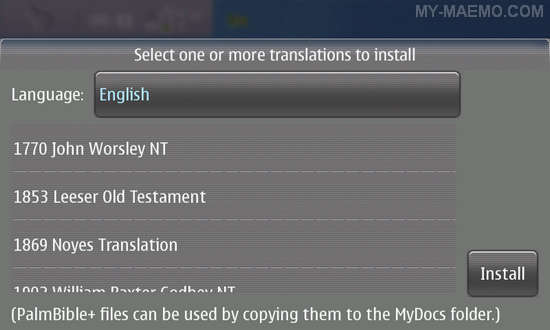
Where Are the Bible Database Sources App Developers Can Use?

screenshot of Katana, Maemo Linux open source bible reader
The other day, we received a question asking about the location of Bible databases which would be suitable for using for mobile apps. This is something of an undocumented search I’m afraid, as much of what ends up happening either doesn’t get talked about, or falls under the conversations about copyright, licensing, and digital use we hear about from time to time.

While I was able to give the respondant an answer, I thought it a good idea to also share that answer here and ask you where you might obtain your sources for the religious texts that you use within your mobile apps and services.

  • Logos has the Biblia API which is a set of APi libraries into their content database (20,000 items and growing). I do not remember there being any restrictions on using it for other applications, but you will want to check on that.
  • Crossway has the ESV available in both a packaged download (not necessarily a database) and API calls to their server. There is some restriction on usage
  • Bible.org/NET has the New English Translation (and notes) available as a packaged download. They are working on an API into their texts. Refer to their website for specifics, and you would probably end up crossing paths with many others attempting the same
  • CCEL has several Bibles (many past copyright) and Biblical content. Much of it is in semantic HTML4 documents, packaged as zipped archives. All of those are free to use as long as you keep the attribution in your source documents.
  • The WEB (World English Bible) is mostly an open licensed text, I am not sure of the state of their content [in respect to being usable for inclusion into web/mobile applications or services].
  • You might also want to look into Open Doors and Door 43, as they have been working on an open licensed text/audio biblical library. Their project is in process.
  • If you are looking for audio, your main/best resources are Faith Comes By Hearing and GRN. They do make content deals with [organizations and] developers to offer the content based on you providing to them metrics about use/downloads/etc.

Then there’s BibleDatabase.net, the e-SWORD modules library, and I’m sure a few others that I’ve simply forgotten.

Perhaps, in helping to answer the question of licensing and access, hearing about the challenges around discovery and implementation might lend towards some obvious solutions in this space.

If you have a listing of Biblical sources, definitely respond in the comments. If the list grows sufficiently, then perhaps this information becomes something else added to our page of resources for developers/organizations.

Has Your Ministry Started Doing Mobile Marketing

Mobile marketing image
A neat piece over at MobiThinking talking about the beginning steps for doing mobile marketing has been published:

The mobile phone is an incredibly versatile device. It can take photos and videos, and send them anywhere in the world, instantly. Many devices know where you are, the more advanced ones even know in which direction you are facing. A quick search on the mobile Web will help you find the nearest branch of your favorite store or restaurant chain and a mapping app will guide you there. A well-targeted offer via mobile ad or SMS might tempt you into this outlet rather than another. In store, you can compare the price of a product here with prices elsewhere simply by scanning the barcode on the packaging. When a print, TV or outdoor ad interests you, mobile gives you the chance to find out more, sign-up, interact or make a purchase there and then.

With virtually all consumers carrying a mobile phone in their pocket all the time, it’s no wonder that all shrewd marketers are looking to engage with customers via mobile, but with a bewildering choice of options, and numerous pitfalls, it is understandable that companies don’t know where to start. These basic tips will help you get your mobile strategy started off on the right foot.

Here are those tips in summary:

  • Seek Permission
  • Start with the Strategy
  • Build A Mobile Website
  • The Power of App
  • Mobile Advertising
  • Loyality Tool
  • Location-Based Services
  • Measure It

Read the full article at MobiThinking.

What have you or your ministry had success with? Any areas where going mobile would be great, but you are having issues?

Bending Web’s Intent

If there’s anything that is true about the effect of the Internet (there is a lot that is and isn’t), there’s a bit of a truth that you can bend files and connections a bit more than you had before. And when you do, the possibilities are pretty amazing.

For example, if you are a fan of website, web app, and mobile/tablet app design, there’s something really interesting that’s taken place with the design of the Guardian iPad app. Yea, there’s the obligitory discussion about making sure that you are paying attention to reading on a tablet, versus reading paper, versus reading on a smaller-screened mobile. But, there’s also this attention paid to “how” an article is put together in those different reading frames, and redesigning the production not just what the person consumes at the end. Bending, not necessarly reinventing.

Then there’s a semi-project that I’m getting back towards. After not having a mobile web server on my mobile device(s) for sometime, I’ve managed to put back onto it a PAMP setup that I am augmenting with TiddlyWiki. Essentially, I’m looking to reset some of the web-docs that I’ve been doing to a more wiki-like site, and then leverage the web services that I can connect to my device (Dropbox, ifttt, etc.) to share and collaborate with others. this isn’t a public-facing server, but does allow for some interesting explorations in HTML as a starter for documents. Again, bending, not exactly reinventing.

These are just two of the ideas happening. If we are going to be in this domain, then it makes sense to experiment with ideas that bend further. Are you or your organization bending the web beyond conventional means and methods? If so, and its shareable, what are you learning new?

Carnival of the Mobilists No 274

Keeping up with the major stories in mobile is the job of mainstream and larger niche publications. Keeping up with off-shoots on those stories, as well as notable smaller points that sometimes gets missed by those larger sites is what the Carnival of the Mobilists serves towards. The Carnival of the Mobilists (CoM, @themobilists) is a weekly collection of writings from around the web speaking on whatever was notable in the past week in mobile technology. This can take the form of posts, interviews, and even the occasional video blog. In addition, each week sees the CoM hosted on a different website.

The latest Carnival of the Mobilists has been up at Blog.AntoineRJWright. For past and future CoMs, check out the Carnival of the Mobilists website.

Would be good to see more Christians contributing to this [hint, hint].

Can Data Expose the Depths of Mobile/Digital Faith Efforts?

screenshot of email image from YouVersion showing Top 10 Bookmarked verses from their service

About a week ago, I received an email from YouVersion noting the top 10 bookmarked verses within their application. This is quite valuable information, especially if you are apt to advise people to use their digital tools in order to engage the Scriptures. Now, the fun comes in taking this kind of information and trying to make some sense of it. Upon receiving this, I tweeted an honest and business intelligence -like question:

Top 10 bookmarked verses in @youversion; the needs of digital believers can be summarized in these perhaps?

Why these verses? What about these verses speaks to the needs, or at the very least the attention spans mentally, spiritually, and socially to believers? Does this point to how mobile has fostered spiritual transformations (transformations)? Let’s see.

(1, 5, 6) Philippians 4:6-7, 13

Do not be anxious about anything. Instead, in every situation, through prayer and petition with thanksgiving, tell your requests to God. And the peace of God that surpasses all understanding will guard your hearts and minds in Christ Jesus… I am able to do all things through the one who strengthens me.

Anxiousness tempered with prayer and thanksgiving. Not exactly the instant nature of mobile. One could argue that this is intentional friction to life if considered on this frame.

(2, 7) Proverbs 3:5-6

Trust in the Lord with all your heart, and do not rely on your own understanding. Acknowledge him in all your ways, and he will make your paths straight.

Having moved to prepaid instead of post-paid, I am seeing my trust stretched (amazing what a buffer missing doesn’t do in terms of keeping you off track).

(3) Jeremiah 29:11

‘…For I know what I have planned for you.’ says the Lord. ‘I have plans to prosper you, not to harm you. I have plans to give you a future filled with hope.’

Do we know what Facebook, Amazon, Apple, etc. have planned for our uses of their devices and services? Probably not. But we do have a sense of God’s leaning towards us.

(4) Romans 12:2

Do not be confirmed to this present world, but be transformed by the renewing of your mind, so that you may test and approve what’s the will of God – what is good, and well-pleasing, and perfect.

Well, it might be a bit late for this. There are more people who use mobiles (+4 billion) than who are Christians (~2.5 billion). What isn’t too late to happen though is a pattern of behavior that is distinct in it’s goodness, appeal, and viscosity while mobile and connected. I would argue that this verse isn’t taught in this way (again, a mobile filter here). But, if it were, what would Christ-thru-mobile look like?

(8) Romans 8:28

And we know that all things work together for good for those who love God, who are called according to his purpose.

This is not something people feel when their favorite platforms and devices are no longer supported. But, again, it is a state of mind and affairs of the believer. Accessing this verse on a mobile is probably in context of knowing that some moment isn’t, but that the word (and device) is timely in its encouragement.

(9) Matthew 6:33

But above all pursue his kingdom and righteousness, and all these things will be given unto you as well.

The structure of this verse lends itself to having to read all of the context before it. It’s not that you get anything, but only those things that are necessary for life and godliness. I hope it’s taken in that context by those bookmarking it, because if you are leaning on this to get that next mobile, you might be following the leanings of the wrong god.

(10) 1 Corinthians 13:4

Love is patient, love is kind, it is not envious. Love does not brag, it is not puffed up.

Man. This is the kind of verse that makes all of those customized cases, skins, themes, and ringtones feel a bit worse for wear doesn’t it? Does our use of mobile demonstrate the kind of love being detailed in this section of Scripture? Or, is this marketer a reminder for the kind of love that needs to resonate through each service and application on these devices we use?

Interpreting the Data We Can See
Can the life of the digital believer on YouVersion be identified as Christ-following if we use just this snapshot? Clearly they walk through some of the more accessible passages in the text. There is also some kind of leaning towards the spiritual, emotional, and psychological health of the reader. We don’t know how often these are referenced, nor how often they are bookmarked.

To the the dismay of some, there isn’t one evangelical verse in here. To some, there is an almost hotel bible approach (NT, Psalms, and Proverbs) – so where are the minor prophets or even the Pentatuch?

If you teach the word, do you lean on these and other popular Scriptures as memory devices for the hope and help of the believers you are serving? Or, has this simple statistic from one of many applications that have been used on mobile devices shown the lack of a solid, secure, instructional view of the entire Bible (66 or 80 books)?

What Other Data Is There Worth Mining for Value
It is very true that just collecting and trying to interpret data for the sake of doing so is a fool’s errand. There’s a lot of knowlledge that can be gained, but very little understanding if it has no context. Something that I wondered in looking just at this snippet of data that YouVersion shared was what other kinds of information could they offer? For example, if there’s a top bookmarked verses, there’s also a least (where least is greater than 0 or null). There’s some kind of data wrapped around frequency of verses during times of the year? And possibly there is some regional variation towards which parts of the Scriptures are more tuned in towards than others. In a very simple sense of things, YouVersion and other similar service providers, sit on a bounty of information that’s just waiting for the right questions to be asked of it.

Would YouVersion, Logos, Accordance, Olive Tree, and others be open to these kinds of questions towards how people are using their applications? Shoot, it would just be interesting to compare the top bookmarked verses in each of these service-app platforms just to see how they are used differently. Would pastors/teachers be apt to know how to ask for this information (“hey, I know that these people following me in your app-service attend my church, is there any way to get a custom report towards how we all do in terms of general reading and searching data?” is the kind of question that I’m leaning towards. For those who use the group settings, this kind of information can be a boon.

What if we find out something that turns us off? Like people don’t read their Bibles but once a month in these apps. That many people are more apt to remember the app when their devices say to update, rather when they are admonished by their community to meditate on a specific passage (Joshua 1:8)? What could we do with the information then? Does mobile expose digital faith as helpful, a hindrance, or as just another Hebron between us and God?

Do You/Would You Use Anonymous Browsing on Your Mobile

slide from Mobile Ministry Forum Mobile Security Issues Webinar
For a little while now, I’ve been looking at security and anonymity as they relate to mobile. Truthfully speaking, there’s no such thing as being completely hidden when you are using anything digital and connected, though there are ways of layering your use so that it is at least a little bit harder for someone to find you as the needle in their haystack. I’ve been particularly interested in services like Tor which not simply a browser, but a means of “bouncing your communications around a distributed network of relays run by volunteers all around the world: it prevents somebody watching your Internet connection from learning what sites you visit, and it prevents the sites you visit from learning your physical location.”

The other week on Mobile Active, I saw something going down this line with a guide to using Orbot and other anonymous browsing tools on mobile. This really is interesting, and for good reason, there isn’t just the case of governments looking at you, private companies do an even more impressive job of keeping your tabs.

There’s also the perspective of carriers, which was highlighted recently at MobileGroove. While there is this understanding that conumers of mobile are thinking a bit more critically about the implications of the data that passes through their mobile devices, this is also presented as an opportunity for carriers and other information agencies to unpack options for some who would like things to be a bit more secure.

Mobile browsing, and the challenges for consumers, carriers, governments, etc. was discussed during the Mobile Ministry Forum Mobile Security Webinar. Check out this audio for discussion.

So here’s the question: do you use anonymous browsing tools or methods on your mobile? If not, would you consider doing so, even if you were in a country that is more open about where and what you can do in digital spaces?

FrontlineSMS Version 2 Announced

screenshot of Annoucements panel for FrontlineSMS 2
While at the Biola Digital Ministry Conference, there was a heaping of conversations about mobile apps and mobile ministry strategy. But, the best question came from a few brothers from West Africa who not only see the potential for mobile tech in ministry, but see it from a context that is altogether a challenge for some of us in [more] developed nations to understand. Primarly, their instincts for mobile begin with non-smarpthones and SMS. While I could mention a few activities underway and the (small) collection of resources we’ve put together, not being able to get them up and going before we parted from the conference was a downer.

Perhaps God had my excitment to come later for a reason. The introduciton of FrontlineSMS version 2 came not too long after the start of our conference. And now, a few weeks later, I’m getting a chance to take a look at what seems to be an impressive and exciting update to what has already been an oft-recommended product.. In terms of solutions for creating and managing connections via mobile, you will find it very hard to do better than this award-winning and open source SMS (text) messaging tool:

What’s different about the new platform
FrontlineSMS Version 2 makes it easier to create and manage common SMS activities like making announcements, conducting polls and automating replies to incoming SMS. Our polls activity visualizes incoming data, allowing you to quickly understand the results. You can manage messages more easily with a flexible filing system, featuring folders and an archive capability; as well as an inbox, outbox, and the ability to monitor pending messages. Important messages can be starred for later, and a more robust search allows you to locate messages based on name, location, or date as well as by activity, group and folder. You can export your messages limited by date range, or from any search result, collection of messages or group of contacts.

The architecture of the new software makes it stronger and more flexible, allowing developers and users to customize FrontlineSMS to better meet their needs, and integrate it with other platforms and systems. Browser-based and built to run on Windows, Mac and Linux, FrontlineSMS still does not need the Internet to work, sending text messages via a phone or GSM modem. Online SMS aggregators Clickatell and IntelliSMS are already built-in, for those with a web connection, and more services will follow in the months to come…

Read more about FrontlineSMS 2 at the FrontlineSMS Blog. View a walkthrough of some of the updated and new features of FrontlineSMS 2 here.

If your organization has deployed FrontlineSMS or similar SMS services for communicaitons we’d like to hear about your progress and successes (and even failures). These are the kinds of stories that mobile minsitry practioners pine for at conferences like Biola and many others.

Identifying Non-Textual Mobile Language Opportunities

Gorillas talking using baby-talk, via National Geographic
Over the years, we have seen the acclimation of gestures and emotion-based icons as part of the vernacular of mobile communications. For those with some Nokia and Android phones, gestures such as flipping the mobile over to ignore a call or silence an alarm, have become normal – while still denoting a sense of the magic of what these bricks of sensors and antennas can do. For Many who are into their 2nd and 3rd touch-centric devices, pinching, swyping, and rhythmic tapping have led to interacting not just with the content on a linear level, but also has allowed for some psychological attachment to the content on devices. All of these are great, and in fact, becoming more core to the experience of not just mobility, but computing as a whole. An enduring lesson though should be derived from this:

Technology is part of the Biblical Story. It transforms the world and us.// Mediums communicate meaning & shapes thinking. #bioladigital (@neverarriving)

Now, while that was something stated on Twitter, and could at one point be thrown aside as a “sure, that makes sense” kind of comment. When we look at some of the research and observation towards language and learning beyond computing, we can begin to see that there’s a bit more at play with gestures and non-verbal communications which begs the question about not just our interplay with devices, but how these non-verbal behaviors can improve our relation to one another, or even our fatih experiences.

Take for example this observation of gorillas from a recent article at National Geographic:

In 2011, Luef and co-author Katja Liebal recorded video of lowland gorillas in two zoos: Zoo Leipzig in Germany and Howletts Wild Animal Park in the United Kingdom.

The team observed 24 gorillas, which they separated into four age groups: infants, juveniles, subadults, and adults.

The scientists focused on the animals’ behavior during play bouts, which are started and ended via nonvocal communication-an exchange of signals involving the head, limbs, and body posture used to manipulate another gorilla’s behavior.

Analyzing the video footage, the scientists then noted each gorilla’s nonvocal signals.

The team saw that gorillas in the three older groups touched infants more, which may be because the youngsters themselves communicate with their mothers via touch, Luef said.

It could be easy to dismiss this as something just needed for language and cultural studies, but I think that there are lessons here also for the mobile-tuned fatih communities in which we live. For example, when we see someone fondoling their mobile while in a conversation with another, or while in the midst of a group discussion – what kinds of messages are transmitted? Or, when you see a group of people at a concert or group event all throw up their mobiles as if they were flash lights and cigarette lighters – what kinds of experiences are they sharing with one another that might only be remembered again from a photo or video of the moment, versus a telling of it (“it was amazing, you just had to be there”).

Don’t get me wrong, I think there’s a place for text-based communication methods. As is there a place for pictorial (still and moving) and audio based comms. But, I do wonder if we aren’t also looking at some of the other ways in which we communicate, learn, and adapt ourselves to one another and our environments that are much more non-verbal. We’ve talked about in a previous article how even the keyboard can be augmented with a picture-based system that allows it to better target non-literate and multi-linugal contexts. There’s definitely an opportunity here.

I’ve seen with just the adaption of gestures on mobiles that there are ways in which we want to interact with data and one another that just aren’t as able to be captured with text and buttons. There’s room for more, but can the greater faith community break out of its diacletic/rhetoical leanings enough to see fatih practices that are augmented with computing look a bit different?