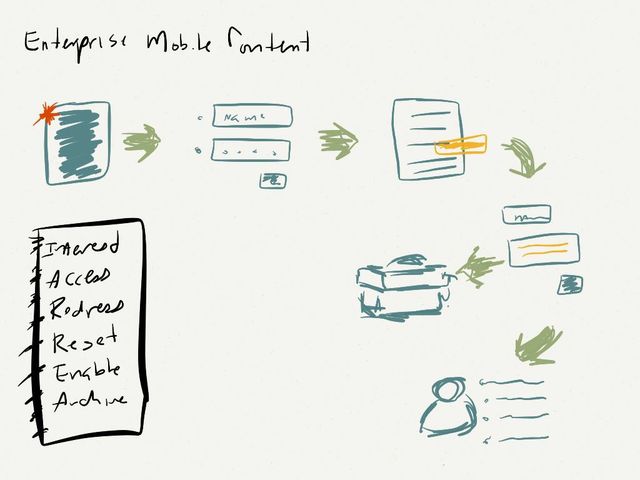
Now that we have a methodology to embark on practice of doing mobile ministry, how about we take it a bit further with thinking about how a person engages your mobile product and their basic behaviors in that engagement process. You can think of this along the ‘Experience’ focus we talked about when we described layers or focuses of mobile ministry.
Here are the steps of mobile engagement:
- Interest
- Access
- Redress
- Reset
- Enable
- Archive
Interest
First, the mobile product has to engage the user’s sense of interest. Interest invokes curiosity to investigate the experience further. If it doesn’t seem interesting (active interest from it being discovered by the consumer or passive from it being described/marketed from a 2nd or 3rd party perspective), then it will not be engaged. Its not just the content therefore that makes a play here, its also that “judging a book by its cover” perspective. Does whatever the mobile product wants to convey come across as relevant to the consumer (remember: technology is only relevant when it is personal)? If no – meaning that it makes sense to shareholders and developers, but not the actual users – then there’s a good chance that continuing forward is a losing proposition. If yes, then we’ve got something to work with.
Access
Secondly, the mobile product has to be accessible. Accessibility doesn’t just mean catering to those with detuned sensory capacities, it means that aspects of doing whatever behavior the mobile product wishes to engage us in is accomplished easily. A good term here to use is “frictionless.” Meaning that after it was interesting enough to try, that the mobile product was also effortless enough to dive into.
There are times when adding friction to the experience might be necessary – for example, you are creating a mobile service and some form data needs to be filled out by the consumer. In this case, access needs to also be effortless, but also take into account that someone is on a mobile device (so asking them to check their email for a special code to activate an account might not be the best method of access engagement).
Redress
I will admit, I used this word because it rhymed. But, when you look at the definition of ‘redress,’ you see exactly the point that’s being conveyed here. Now that a person is engaged within your mobile product, what is to be solved, alerted to, or changed? How easy is it for a person to determine this? Remember, we had that frictionless/effortless step to access this mobile product. That approach needs to continue here if the product will remain in a positive light.
Reset
This is the fourth step listed, but could easily be step 3B. After the user has been prompted to redress within the mobile product, how do you reset them to that same state they were in when you product was accessed? Did your message prompt clearly state what changed when they addressed updating their profile? What about achievements – what are you doing to show on a mobile screen, or for a mobile context, how much progress towards addressing the product’s purpose is easily discerned?
Enable
Every application has to have an enabling point. If you will, as the mobile product is being engaged, what is being enabled? What should the consumer of your mobile product be enabled to do after they leave your product? Does your product even have such a goal, or does it just stop at collecting information (or like some church websites do you simply enable people to locate your building, but get no reference as to the actual pulse of your community’s engagement to the Gospel)?
Here’s where you start (re)asking the question of whether your mobile product fulfills the definition of mobile ministry. If it can clearly support all or part of that definition, there’s a good chance that you enable a maturing of the faith of the individual, community, and faith group.
Archive
What actions need to be forgotten? What needs to be stored for reference for the next time the mobile product is engaged? The final step – after you have enabled the consumer towards some mobile ministry behavior – is to archive what is no longer needed, and store for easier access later whatever is vital for your mobile product’s experience to stick. Simplicity and discretion is needed here. For example, after you’ve successfully built and deployed your text messaging (SMS) prayer list or announcements, how you archive the value of that first time experience in their minds/behaviors determines how often they come back to using it. So you don’t just give someone instructions for managing an SMS account once, you program that system to remind the subscriber at regular intervals how they can stop/edit messages, get help, etc. You talk about some of the successes or efficiencies gained in that communication channel as they happen (via blog, social media) or with a larger group at regular intervals (during announcements section of church service for example).
Managing Mobile Ministry Experiences Starts with Understanding the Consumer
You cannot just expect that just because you have created a ministry-centric product that it will be used. As a matter of fact, you can expect that not only will it not be used, but it won’t be used how you have designed it. To avoid those kinds of misplaced expectations, understanding not only your produced product, but the steps people take in engaging your product helps you spot the gaps in your approach and point out efficiencies that can be gained when your product moves into its future iterations.

 During the month of January, we posted six articles which corresponded to five resolutions suitable for those working in and around mobile ministry. Having moved through April and are now in May, how are you doing in terms of these or your personal/organizational resolutions?