Monthly Archives: November 2011

Mobile Beyond Missional Evangelism

Mobile Ministry Sketchnote Mindmap - Share on OviI was recently exposed to some information that has me looking a bit more circumspectly around the aims and demonstrations of mobile ministry. That information, though confidental in orgin and application, does open a point that is a bit more openly talked about – the need for something beyond missional evangelism as methods of engaging and maintaining faith communities.

Beyond missional evangelism? Yes. Beyond simply reaching outward with messages of salvation. Where are those efforts that reach into the fabric of lifestyles, usually lifestyles which leave little room or consideration for finishing the thought, “what are the ethical and spiritual implications of this course of life I’ve chosen?”

Some of us have heard of efforts such as Business as Mission (BAM), where the aims are to transform the economic fortunes of a community by using the Gospel as a foundational method for training, apprentiseship, and business sustainability. What happens when mobile ministry applies some of the same constructs towards its efforts? I think that we get something that looks like an extension of the experience layers that compose Mobile in Education/Discipleship, Mobile in Media, Mobile in Analytics/Development/Marketing, and Mobile in Missions/Evangelism (read our previous discussion on these areas of mobile ministry).

If you will, instead of starting with “let me give you this religious application,” we go the route of “let me train you will this skill that will enable you to share your life, while displaying a lifestyle that mimics Christ’s.” This can look like creating software developers, but I think that it also looks like multi-linugal teachers. It looks like the person who build the nets for fishing who is learning on the side how to create classes on how to manage issues with his family as a community counselor. It looks like the oral story teller who is learning how to record themselves on video for younger age groups. Or… well, what does it look like?

That document that was shared with me asks that missions takes out of its head this idea that there’s a funded group of persons for short and long term engagements and exchanges that for persons capable of starting and maintining businesses which speak to the need for economic and spiritual enablement in those areas. Given what I’ve seen from rural, urban, and international missional engagements, I think there’s a good chance for spiritually-driven entreprenurs to pull this off. For mobile ministry, this might be the best course of sustainability.

Your thoughts?
A Church Based on Movement not Preaching

We hear it in sermons often, “the church isn’t what happens in the pews on Sunday, but what you do in your communities throughout the week.” And yet we continue to place the event of sitting for singing and the preached word as central to the sustainability of faith. What if we could be the kind of roving fellowship to which a static location wasn’t key to spiritual sustainability, and the types of interactions as well as our travel in between them, became the mode of living? What if fellowship was determined to be most effective when it was a series of smaller, sometimes more random, meetings, and then the weekly gathering was a look at the stories that happened in those moments – a weekly YouTube channel of your social connections around your city and places of life/work/entertainment? Would it look something like the Mo Mobility System?

I hear it often from pastors that they’d want more members that think and act like this? But, without incentives for organic fellowship, or being able to model such mobility to people who aren’t single, entrepreneurs, or upwardly affluent to gather like this, how could you pull this off? Is reinventing our cities the answer where our churches aren’t able to move out of that behavioral caste?

We See Through the Glass Darkly, Then Clearly

One of the transitions that have been taking place within myself, and in many respects this site, is a transition of moving from mobile as something novel for ministry to mobile facilitating behaviors while are more sustainable after the luster wears off. Contributing to this transition is this understanding of the waves of innovation, prosperity, statis, and decline that we see throughout generations of just living (Genesis 8:26). Technologies themselves are driven by these flows. And to see the present moment clearly, you’ve got to bend your eyes into seeing what used to happen.

Over the past couple of centuries, we have had a technology revolution every 40 – 60 years, starting with theIndustrial Revolution in 1771, which was characterized by the emergence of machines, factories and canals. This was followed by the age of steam and coal, iron and railways which started in 1829; steel and heavy engineering (electrical, chemical, civil and naval) starting in 1875; and the age of the automobile in 1908. Our present information technology and telecommunications age, whose starting point Perez pegs at 1971, is the fifth such major revolution in that span.

Each such technology revolution is composed of two very different periods, each lasting 20 – 30 years. Theinstallation period is the time of creative destruction, when new technologies emerge from the lab into the marketplace, entrepreneurs start many businesses based on these new technologies, and venture capitalists encourage experimentation with new business models and speculation in new money-making schemes.

Finance and entrepreneurs are the drivers of the installation period, whose key objectives are to leverage the technological revolution to replace or modernize the old with the new. But inevitably, unrealistic expectations in the emerging disruptive technologies lead to over-investments in new companies, unrealistic business models and speculation in all kinds of money-making schemes. These behaviors invariably lead to a financial bubble, which eventually crashes and results in a period of economic stagnation.

After the crash, comes the deployment period, the time of creative construction and institutional recomposition. The now well accepted technologies become the norm. Infrastructures and industries start getting better defined and more stable; and production capital drives long-term growth and expansion by spreading and multiplying the successful business models. New paradigms emerge for guiding innovation. Over time, these new paradigms significantly transform the economy and everything around it, as well as re-shaping social behavior and the institutions of society.

Read the rest of Unleashing the Next Age of Prosperity at Irving Wladawsky-Berger.

Really. Is easy to be caught off guard by the speed and innovations of new behavioral and technological paradigms. We can see that in some of the tone in the Gospel Collation article “The iPhone as Hitchhiker’s Guide to the Galaxy“. And yet it is through this reflective lens of what has happened that we move into doing more clearly what does happen. What surprises us, or could surprise us, is that wisdom and excitement of growing more into what it is that God has created us to be while on earth.

While on earth… Really, we see this tech and our behaviors with it as something that is only a glimpse of what is to come. What we gain in looking at it honestly, retrospectively, and even zealously, is this taste of what will be. However, the key is not getting stuck on the taste that we have now and allowing our glasses to clear with better view, a more full/empty view of what is probable. Our behaviors and perspectives then move towards this viewpoint, only to be challenged and changed again when it’s time for that glass to be refreshed.

Cheap Knowledge, Expensive Meaning

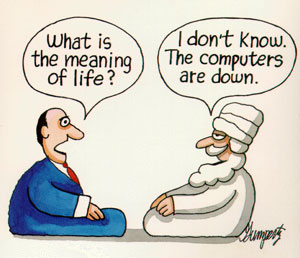
meaning of life, computers are down, comicInvolved in a number of conversations this past week, there’s been this sense that there are two types of people involved within IT: those people who are after information, and then those people whom are about meaning. We see a similar break in life when we think about theology and hear that some topics are better discussed in seminary settings, or that the local church is more about applied theological leanings. Is this respect, I wonder if we do more damage than good because meaning then becomes constrained than enabled.


Or, at least that’s been the line of thinking that I had come thru my mind when reading Information is Cheap, Meaning is Expensive from The European:

The European: Which brings us to the question of what it means to be alive. Biology, philosophy or religion might answer that question in very different ways.

Dyson: That is a huge and unanswered question that we are unlikely to agree on. Life is whatever you define it to be. There are some clear examples of intelligent life: A kitten is clearly alive, and a human being is clearly an intelligent living being. But very quickly you get into murky areas where the answers are much less clear.

The European: Do we have to embrace the uncertainty?

Dyson: It becomes a question of judgment. Barricelli pushed for a very broad definition of life. In the 1950s, we were just beginning to travel out into space and perhaps discover an answer to whether there might be life and intelligence outside of our planet. Barricelli was concerned that we might not recognize life or intelligence when we saw it, because our definitions of what it takes to be alive or intelligent were so narrow.

There’s more, and I’d encourage you to read and consider some of the propositions put forth in that piece. Specifically, look at your mobile ministry activities, or even your social media and other broadcasting-type activities, where are you simply pushing forward information, but leaving meaning to be narrowly defined, or even alternately defined, by aspects of technology and culture.

Then again, is such kind of thinking and activity even a part of your/your organization’s methods of pushing things forward? Many of those I’ve spoken to are in such a frame of thought and life that they literally don’t think like the other streams of life do around them. For you to think and then do something that’s not be done “quite that way” before is indeed advancing thought and activity beyond certain paradigms isn’t normal. Franky, its painful. So in your moments where you aren’t “making a living” are you stepping into a meaning of life that build on what was known (information) but infuses into life something different?

Yea, its expensive to do such a trip. Am learning that one…

Mobile Advance 10 Questions Series: Antoine RJ Wright

Mobile Ministry Forum - Share on OviOver at Mobile Advance continues their 10 Questions interview series of people involved in and around mobile ministry activities.

The latest of these interviews is with Antoine RJ Wright (wait, that’s the guy who runs this place). Here’s a snippet of that interview:

5. What are some of the biggest obstacles to implementing effective mobile ministry? For you/your ministry? For the Christian world in general?
 
Mobile is still very new for many ministries. Some have just figured out how to get on the Internet train consistently, and mobile adds a layer of knowledge and engagement that should be familiar, but has unique challenges many aren’t ready to answer. For MMM, our challenge is getting people to talk about their challenges and successes with mobile. We’d be just fine if there was an easier way to get folks to document what they are attempting. For the Christian world, mobile is just big. And its unique in every instance. Many don’t focus on discipleship as much as they do activity and teaching, and so they miss that personalized level of life that mobile and discipleship tend to sit on. Mobile requires that kind of on-the-ground relationship…

Read the rest of this interview at Mobile Advance.

The Finer Points (and Kerning, and Leading) of Mobile Design

Font sketch diagram of Nokia Pure font

A large sheet showing the Arabic alphabet is completed with hundreds of Koranic markers. A pair of annotated brackets signify a quote or reference to the Koran, and a series of characters grouped together spells out the salutation – Peace be upon him.   

Nokia Pure has been specifically designed to accommodate the Koran in Arabic, and the Torah in Hebrew, reflecting the fact that in many parts of the world mobile devices have become an important religious resource.  

Now with the first phase of the project near completion, Bruno Maag is looking ahead to the next set of languages. He has started working on Armenian. “Not many people speak it,” he says dryly. 

The result of all their efforts, Nokia Pure, is a humanist sans face font – without serifs but with different weights and thickness on the strokes. Maag points out the small details that make the font unique:

Read the rest of Typographer Bruno Maag on Nokia Pure: Exclusive Interview at Nokia Conversations

This is a lot more than most want to know about fonts; but speaks to just how intricate the mobile environment is. You have to include context in every measure, especially in the case of fonts where you are ascribing literacy to the experience.

Carnival of the Mobilists No 253

Carnival of the Mobilists logoThe Carnival of the Mobilists is a monthly blog carnival featuring some of the best perspectives in mobile from around the web. Each month has it hosted at a different website, and this month’s host was Tomi Ahonen/Communities Dominate Brands.

Tomi wrapped the September collection of posts around David Bowie’s Changes – which makes for a rhythmic, unique approach to reading this month’s contributions. Besides my own, do make sure to check out others who were included in the 253rd Carnival of the Mobilits.

Of note to those of you in mobile minsitry (#mobmin), you might want to add to your note books the posts from Martin Wilson, Sacha Vekeman, and Steve and Alison Hoober as these posts have direct corellation to activities in this space.