Monthly Archives: October 2011

What I Wish My Pastor Knew About: Responsible Engineering and Technology – from Ministry Theorem

As an engineer, it strikes me as odd sometimes that many Christians I know will expend a great deal of energy and passion arguing about theories of science, while at the same time unquestionably accepting nearly every new technological development that comes along. Perhaps you know Christians to whom mentioning the age of the earth or evolution can trigger heated debates. On the other hand, for these same people, mentioning nuclear power or the need for sustainable energy technologies usually results in blank stares or shrugs.

This seems interesting to me because, while scientific explanations of history can be fascinating (as other essays in this collection have no doubt demonstrated), they rarely impact our daily activities in the way that technology does. After all, technology shapes our lives from the moment we crawl out of bed in the morning (perhaps from our visco-elastic “memory foam” mattress, made from a material revised and adapted for this purpose only within the last 10 years) and step into the shower (where we enjoy an almost immediate flow of water obtained from a massive water treatment plant via a complicated piping system and heated by a water heater powered by natural gas). Consider the impact that ubiquitous electronics technology has each day on how we spend our time (think televisions, computers, digital music players, cell phones, ATM’s).

So, as an engineer, I sometimes wish that my pastor would encourage people to better appreciate the substantial benefits technology (and therefore the exciting work of engineers) provides, while at the same time encouraging people to be more careful about the technologies they buy and use.

Read the rest of What I Wish My Pastor Knew About: Responsible Engineering and Technology (Gayle Ermer) from Ministry Theorem.

This has been sitting in a window/tab to read on my iPad for a few days and (at the time of writing), I’ve still not gotten to reading the entire piece. Still, the subject and initial paragraphs have been intriguing enough to just poke my mind enough in the direction (again) of wondering how technologists can do a better job of relating to non-techincal fields the Godly value of what we do. I mean, we shouldn’t need God to speak on our behalf all the time (ref Exodus 25 as God making out an industry for certain types of engeineers, craftsmen, and tailors), but it sure does feel like that’s the only way that these two groups would come together for the glory of God and benefit of the entire Body.

~ via John Dyer; paragraph breaks inserted into the blockquote for readability

Conversations and Sketchnotes: Reflections from BarCamp 6 in Charlotte

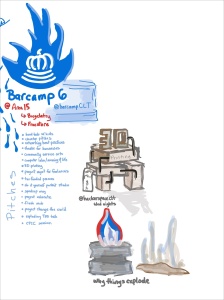
Last Saturday, I attended BarCamp Charlotte 6 (@barcampclt). This "unconference" was in its sixth iteration, and I finally got over there. I wasn’t really sure of what to expect, but came away with a shirt pocket full of business cards, several side pockets of inspiration, and a few sketches that colored my impressions.

The day started off by me realizing that it would probably *not* be a good idea to bike to BarCamp. It was the low 40s (F) and I was in no shape going to be able to bike there with it that cool. Sure, it was going to warm up later, but even in driving there, most of us who weren’t already with a cup of coffee in the hand were looking for that warm-cup delievery.

Everyone got settled in as Adam (CPCC) gave us all a headsup for the day’s activities. First, there would be 30 second pitches by anyone who was able to give one for a discussion topic. The topic would get posted on a large wall and then we’d have a few minutes to mark our vote on the topic by marker or crayon. After the voting was over, the eight (8) highest voted pitches would be placed into one of two sessions (four sessions went on at a time).

The first session that I attended was about how to build a 3D printer by Hackerspace Charlotte (@hackerspaceclt). This was just one of those *too intriguing to miss* presenations. The presentation also included a piece in its second half called "why things explode," which I have to admit being one of those rare times where I kept hearing someone spout off things I didn’t know and was amazed at. Oh, the 3D printer, it apparently costs $350 for the total amount of materials and Hackerspace Charlotte has sessions on Wednesdays where they show you how to make one. Make your own screws, tools, stands, etc., for $350 and the cost of the plastic? Nice.

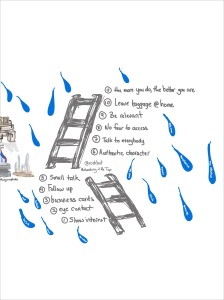
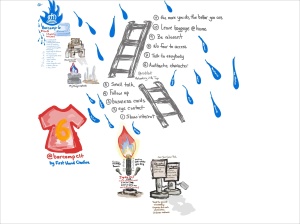
After that was one of the more energetic presenters that I’d seen during the day. Raquel Valez (@rockbot) giving a talk on her top 10 networking tips. From someone who’s merely known her from just following her Twitter timeline, it was impressive that she both did the talk off the cuff but also had 10 solid and very valid tips. IMO, she’s a networking beast and could teach more than networking if she had more time. Was a great talk, and was quite hard to keep with the discussion when others started chiming in (hence the drops of water around the ladder on the sketchnote).

Ah, the sketchnote. See, I had to go that route. There would have been normal notes, but so many people were doing that with iPads. Had to go with my brand ya know. And it goes some decent attention as well. Maybe I should…

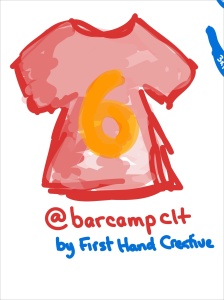
We broke for lunch (I got a BarCamp 6 t-shirt) and then did the pitches and voting again. In this section, I stretched my networking legs a bit and got to talk with several folks who are doing some neat things in and around Charlotte. There’s a lot of energy to just see the entire city do well.

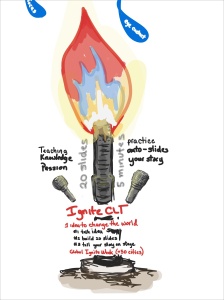
The first talk I attended in the second session was how to give an Ignite Charlotte talk by Bridget Sullivan (@sullybridgetb). Lots of tips there that were applicable for more than just Ignite formatted talks. Now, I do have to admit that I pushed a bit with a question that I had about an interactive talk. And I’ve got ideas on how one could work. But, after getting shot back a bit, I let the sketchnote for that session talk, and I think its something that could come back when its time to submit for topics.

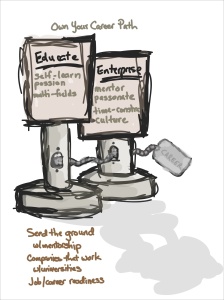
The second and final talk of the day that I attended was about reshaping and refining education given the lack of preparation that people have in coming out of college and those who are in professions but being called to reset themselves in light of jobs and the economy. This talk was led by Bermon Painter (@bermonpainter) and was a nice cap on the emotional and action steps that an event like BarCamp instigates. I think that I was finally comfortable with the crowd because I talked a lot here. But, that’s my heart. Got to change the educational foundations if we are going to do the longest and most sustainable changes to the culture. If there’s a bigger focus on mentoring/discipleship, and then the curriculims focus not on rote subjects but the applicable methods in industries beyond and knitting of those subjects, we can see the changes we desire.

After a few more chats, that was it. The day was long, the weather warmed up, and it was just a bit of a fire ignited in me to continue connecting with several groups and people in the area. I’m looking forward to seeing some of those who attended BarCamp at other engagements in the coming months. And maybe I’ll even get around to fuller conversations with these persons and the initiatives they represent/forward.

One of the attendees of BarCamp and I took some exxtra conversations at Amelie’s Bakery afterwards. I’m really liking that spot as a place to just settle into rest and refreshing. The conversation, much like the connections at BarCamp Charlotte 6, were good towards upping the bar towards how I see and connect with life in this second stanza in Charlotte. BarCamp 7 might see a different me given all of that.

~ crossposted with Blog.AntoineRJWright

Literal Deuternomy 6 Tech, OmniTouch

These words I am commanding you today must be kept in mind, and you must teach them to your children and speak of them as you sit in your house, as you walk along the road, as you lie down, and as you get up. You should tie them as a reminder on your forearm and fasten them as symbols on your forehead. Inscribe them on the doorframes of your houses and gates. (Deuteronomy 6:6-9 NET)

I’m quite interested in the field of wearable computing, especially as I see it relating to the next logical evolution of computing beyond mobile (hardware). OmniTouch is something that I came across while reading. Its a good bit bulky, but does enhance the spatial relationship people can have within computing interfaces.

I also am reminded of seeing something quite similar done with the Nokia N95 smartphone a number of years ago. Nice how history repeats itself, but finds ways of being reinterpreted in another toolset for additional learnings.

Could your practices in digital faith stand seeing digital graffiti of Scripture on the literal hands, hearts, and buildings of man?

[Review] From the Garden to the City – Chapter 8: Mediums

A few months back, I threw MMM’s hat into the running as a participant for the blog-tour/review of John Dyer’s From the Garden to the City with Church Mag. What I didn’t expect was the chapter that we’d land on Mediums (Chapter 8 ) and how appropriate and challenging it is that MMM gets to play in that space for this particular journey.

…John arrives at this discussion about Mediums with some interplay and advancing from McLuhan’s medium is the message meme. And where I can see the connections – for example communication tendencies being placed into formality, speed, and difficulty – I can also see some disconnects that are probably a product of my own training, experience, and profession/vocation – my disagreements with the digital native/digital immigrant discussion. And maybe that’s just it with this chapter, and much of the rest of this book, you get this chance to wrestle with how you’ve perceived the medium of connected technologies of our age (polls, Internet, mobile, social networking, etc.) and filter them not so much through what you know and accept, but what makes sense beyond your perceptions…

Read the entire review of Chapter 8: Mediums; and Follow the rest of the blog tour of From the Garden to the City at Church Mag.

Recommeded Purchase
If you haven’t purchased or read From the Garden to the City, I’d encourage you to read it (at least twice) and to take the observations and lessons into your professional and vocational contexts. You won’t agree with everything (you shouldn’t), but you will be challenged and offer the challenges to your immediate spheres towards the kind of (Berean) inspection that is ultimately more valuable and longer lasting than the next channel or opportunity in this virtual space.

[Presentation] Minutes to Mobile Money at Hackerspace Charlotte

As mentioned in the rash of events post last week, tonite we’ll be at at Hackerspace Charlotte (@hackerspaceclt) giving a presentation titled Minutes to Money: How Africa Hacked the Cellphone and Changed the Credit Card Industry.

This talk (15-20min) will discuss the trend of mobile money (transfer and technologies) and how culture, economics, and mobile disruptions make for a fertile ground for such innovations.

Hackerspace Charlotte is located at 430 E 36th St Charlotte, NC. Feel free to come through. Its a free event,. Though, if you can’t attend, you can view the slide deck.

To those looking for the connection to mobile ministry (#mobmin), its all about understanding the context of behaviors that leads to identifying opportunities in whatever space faith can be a participant in the discussion. For some of you, mobile money has meant simply how you can get your projects or ministries funded. You’ll need to think beyond that frame of thought and activity if you are going to take the activities identified in the mobile money space and make those a case of relevant faith transfers as well. Do add your questions or insights to the comments to this post if you have any.

Notes About Slides
If this is your first time (or its been a long time since) taking a look at slides done here at MMM, we use the S5 SlideShow system in order to create and share presentations. This HTML/CSS/JS format is versatile enough for any device and all that’s needed is a browser in order to view it. Unfortunately, this keeps us from sharing in avenues such as SlideShare, but other networks and methods are easily available since this is simply web and nothing else.

The QR codes are linked to URLs in this deck; and the resources such as Tomi Ahonen’s Pearls Vol. 3 and the Netsize Guide are very good and profitable resources for this type of talk.

Charting an Efficient Path Thru Mobile Ministry Initiatives

Mobile Ministry Mindmap Segment - Share on OviOne of the ways that MMM has been able to help organizations is in respect to breaking down and rebuilding points that influence mobile and other parts of communication events. We do this in part by working every communication issues thru a methodology born out of how we look at the layers of mobile: devices, services, and experiences.

Devices

Devices are agents and windows. What is most important to them is that ability for anyone to use devices for their most efficient and effective communicative purpose. That means that handheld mobiles (PDAs, phones, media players, etc.) speak towards a context of communication events that other mobiles (tablets, laptops, etc.) might not. Knowing the built in abilities and the perceived biases people have towards these gives one layer towards efficien communication. In a very real sense, if you don’t know the device’s abilities, then not much else matters for mobile ministry initiatives.

Services

Services are enablers. Look at services as a channel towards that expected end. They can exist in and of themselves, but the devices and experience design constrains their relevance and effectiveness. What’s usually the challenge here is knowing the bounds of the service inside of your communications needs, and then if it scales with the organic nature of communication behaviors. If it scales, or constrains, favorably, then the chance of a service becominng an integral part of your effort grows. However, service relevance is important here; what’s relevant to the IT administrator is not relevant to the stakeholder (except for cost and time to implementation). Don’t get trapped into making the more important than the other layers, don’t miss that it needs to be working for the Experience layer to be met positively.

Experiences

The Experience layer can be summarized by simply stating, “what are your goals?” Why is this technology, behavior, initiative, or function important to the overall mission of the organization? Is it an experience that is going to govern how others perceive your mission, Christ, etc.? What is the goal of the media transferred to the device? Can that media meet that goal, or is this a matter of planting and watering so that something later can manifest? Are you reaching too far trying to drive the experience? Or, are you not reaching far enough? Once that experience happens, are the persons or their devices evangelists for you, Christ, or something else?

Answering these three layers allows you to chart a path to a solution that’s more efficient than it is amazing. Sure, mobile ministry endeavors want to always “reach the world for Christ.” But, the reality is that the reach of any effort has constraints that you have to identify and then play within. If you will, the path is more narrow than wide, and your efforts have to respect those constraints to see the nets filled.

“And Seek the Peace of the City…”

We keep pushing the fact that to best understand technology’s usefulness, you have to understand the context that it has been introduced into. And beyond that, adapting our perspectives as contexts change and adapt allows that technology to not just be a tool/agent, but a conduit for furthering our application of faith in a consistent and historically respective manner.
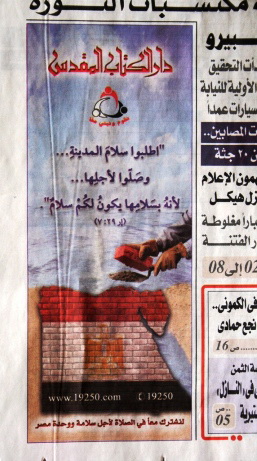
I therefore get a bit of a buzz when reading about what happens in the world around us. For example, in a recent email newsletter from The Bible Society of Egypt, hearing how they adapted the message of Scripture to broker peace in a volatile media environment encourages my heart and adds the right kind of perspective towards how we address themedia/medium of mobile:

…The Bible Society was just starting another campaign in the newspapers at this time, focusing on Biblical values. We immediately replaced the ads with a different message: “And seek the peace of the city… and pray to the LORD for it; for in its peace you will have peace” (Jer. 29:7). Along with our contact information, the short message says, “Let us share together in prayer for peace and unity in Egypt.”

This is the first time we have been allowed to quote a Bible verse in any of our public advertising, and many people, from all backgrounds, have called the Bible Society to thank us for the timely message and positive role. One prominent political figure, the editor of a major newspaper, called to say that he is grateful for all that we are doing to promote peace and unity in these difficult days. We have 16 front-page ads in these coming weeks, in eight major newspapers…

Read the rest of this newsletter and the Rebuild Egypt website to see some of the successes and challenges being found in Egypt.

Yet, this is a mobile tech website, what is the connection?

You are looking to use or introduce a theological/spiritual initiative and mobile is part of the media/medium/context/interface of those efforts. In what ways do you understand both the Scriptures as well as the tone of the culture you are introducing this into in order to have the most successful demonstration of the faith? What resources will you rely on to get this information. You can’t do this like drive-in or drive-by engagements have done in the past. You have to have a distinct knowledge of the pulse of what’s happening, how it’s happening, and then move forward with your engagement.

Here’s the sticky: How can you seek the peace of a city you don’t know anything about? Your use of media will dictate not just that you can be heard, but whether you are listening.

In All Thy Getting, Get Connected

E73 Mode, on its Announcement via iPad - Share on OviI hear enough times, from certain generations/economic classes/ethnicities, that the idea of “community” that has some grounding in “electronic connectivity” is somehow less genuine and less effective than other methods. Of course, these comments tend to come from people groups where there’s been at least a few generations where the social stream has been disconnected from the family/village narrative, so I can understand why that perception lies so.

In this age of information and connected-ness, can one afford to not connect via the methods of the age/class/culture? Sure, we can make choices about some streams (I know I do when it comes to FB, Google+, etc.) – but we’d be missing the conversation of the age if we didn’t connect with it right? Here’s something to that point said in a recent Harvard Business Review piece:

…As the kind of connectedness that social media and technologies like Skype facilitate crosses and blurs the boundaries between social and professional networks, the depth of the relationships that result is often profound. For me, the insight is more important than the size of the input: a light-hearted quip is often more helpful and insightful than a long post or link to a book, or more often now, an eBook. It is about sharing ideas, developing them together, and putting them jointly to good use — this depth increases with the degree of connectedness you have, and in turn sustains it over time.

The most interesting part of social media is how it enables more meaningful connections with friends, colleagues, and advisers. Connectedness in this sense is also about the seamless way in which our communication continues, irrespective of whether we are meeting over a cup of tea or meeting over Skype, sending each other direct messages on Twitter or writing on each others’ Facebook walls, or sharing links and holding conversations in LinkedIn or Google Plus…

Read the rest of What It Means to Be Connected at the Harvard Business Review blog.

While you are considering how you will broadcast your/our faith to todays generations and generations to come, are you also subscribing to the understanding and wisdom present in the behaviors of connections taking place?

Please Turn This Open Bible Visualization into A Mobile Bible Search App

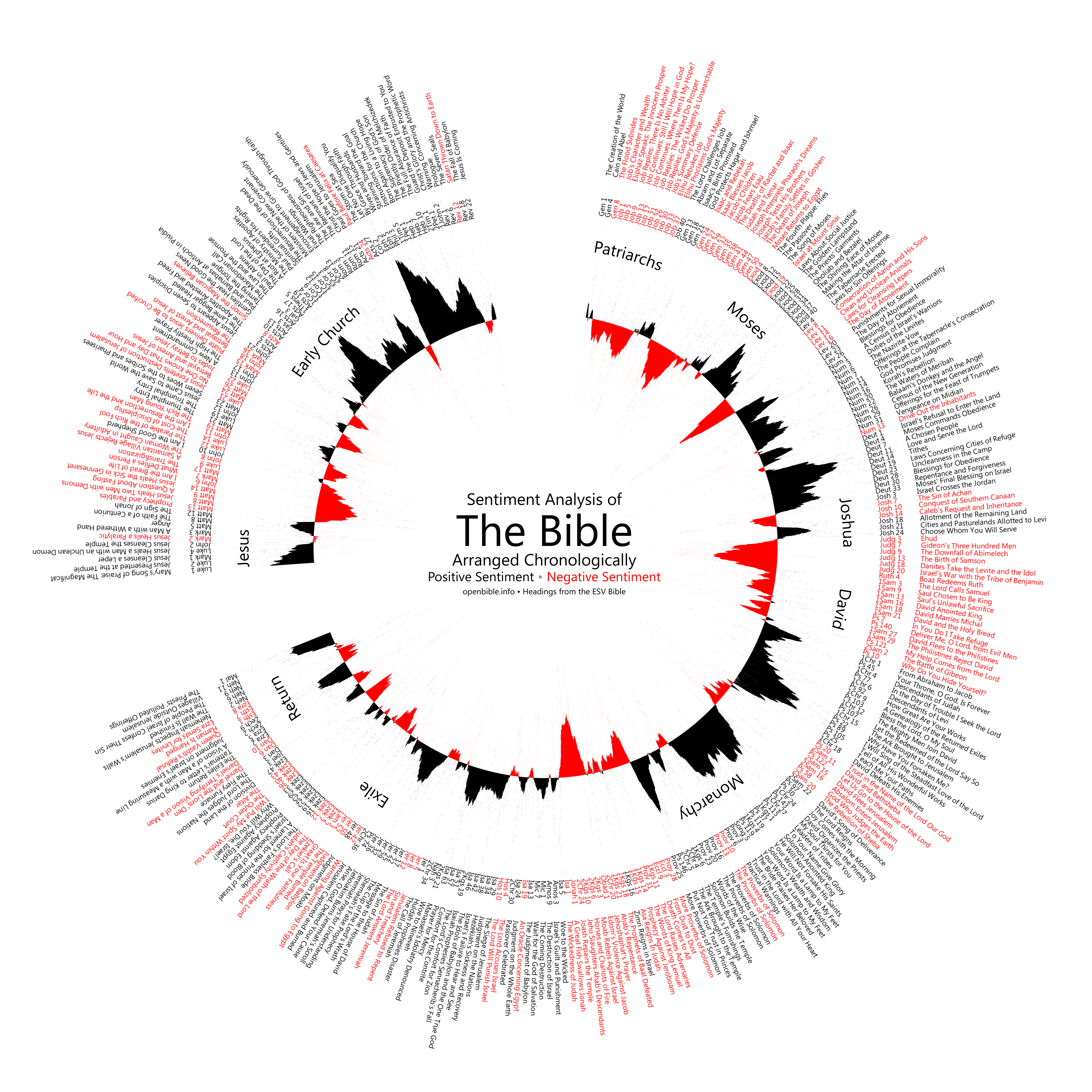
Saw this visualization of a section of Open Bible’s dataset at O’Reilly Radar and instantly thought about this being a spatially-oriented application. Here’s my thinking:

The application would essentially be a single page, similar to Google’s landing page. The page would be connected to Open Bible’s dataset as that’s the only thing you’d be searching against.

You would then type in a phrase or term, and that would display not as a list, but as an zoomed-out (exploded) view of the entire data set. If you will, similar to the image attached to this post.

You would then get a command to press and hold the camera button (or volume button if you are on an iPhone, ha) in order to view into the data. Think like taking a Wii controller and moving around in a small space. That’s what you’d be doing here to navigate around the dataset.

Depending on the data’s output, it could be a circle (like pictured) or something more 3D (like GloBible) or even something 4D (going up/down/left/right/in/out to go through series within the data).

Yes, I’m aware that doing this would seem like it would be physically taxing, but the point here is an application that takes the aspect of searching and seeing associations between concepts and adds your motion as part of your means of tracking with the item. Given that many larger-screened mobile devices have some sense of direction (either through a compass and/or acceleromoeter), this could be something that really works to the advantage of internalizing concepts and placements of context in a similar manner that people describe knowing where something is in the Bible because they remember where it is on the page, not necessarily remembering the address or specifics of the context.

I’m pretty sure that something like what I describe can be done with PhoneGap. And, it could even be done almost completely in a browser, making it basically such that the coding to make this happen would be as open as the data hosted at Open Bible.

So what do you think? And think beyond your use of an app to search and see associations (many of you might be frequent users of Logos and not see the logic in doing a spatial interface like this). Picture how this could translate into taking these smartphones and allowing people who might be more sensitive to motion-interfaces to pick up and understand the Bible because its no longer presented or taught in a stricly linear manner.

Rash of Upcoming Events

google calendar iconGot a rash of items on the plate in the coming months which might pique your interest. These have been (and will be continue to be) talked about on Twitter (@mobileminmag), but here they are for a quick and overall look for you.

Upcoming Presentations

Hackerspace Charlotte Presenation: ‘Minutes to Money – How Africa hacked the cellphone and evaded the CC Cartel’
Oct 25 8-9PM, Hackerspace Charlotte 430 E 36th St Charlotte, NC
Abstract: Discussing the effect of mobile money transfers in Kenya/Tanzania future trends in mobile money transfer

The Geek Fest Presentation: ‘From the Toilet to the Pulpit: The Embrace of Mobile Technology in Faith Circles’
Nov 10 3:45-4:45PM, CPCC Levine Campus, Matthews, NC
Abstract: It is well understood that nearly everyone has a mobile device. It’s also becoming commonplace to see mobile devices used everywhere – to the point that its no longer taboo for people to be found in restrooms using mobile devices. Another area of life that mobile has been quickly finding itself is in religious circles. Starting with Bible applications, mobile in faith circles has moved to educational and media industries to co-bolster those efforts. This talk will describe some of those efforts and how religion becomes the next private place where technology shifts major behaviors.

Call2All Conference ($$)
Nov 29 – Dec 4, Long Beach (LA), California
For more information and to register, visit http://call2all.org
Still hoping to be able to attend this; might not be able to nail doing a presentation though.

Mobile Ministry Forum Consultation 2011 ($$)
December 11-13, 2011, JAARS Offices, Waxhaw, NC
For more information and to register, visit http://mobileministryforum.org

ICCM-Europe ($$)
Feb 8-12, 2010, ‘de Betteld’, Netherlands
For more information and to register, visit http://www.iccm-europe.org/
Hoping to be able to get here as well; sponsorship opportunities available below paragraph at end of this article)

Other Attending Events
BarCamp Charlotte Oct 22nd http://barcampclt.org
Mobile Apps A-Z Oct 27th http://meetu.ps/4CF9l
Responsive Web Design Oct 26th http://meetu.ps/4lC8b

Again, announcements about these hit Twitter first, so stay tuned to use there (@mobileminmag) either via their website or using either of our mobile apps (Nokia/Symbian and Android). Many of the Charlotte (local) events can also be seen via Meetup; as life extends some grace we’ll make local fit into a few more areas.

And to be straightforward, if its possible for to get somewhere to present, and the costs work out (prep and followup are big time sinks), we’ll get there. If you would like for us to share our experience and knowledge and budget is an issue, contact us anyways – faith gets stretched a lot (sometimes more than other times). That’s just the reality of things at this point.

Sponsoring MMM for Conferences/Speaking
If you/your company would like to sponsor MMM for conferences/speaking engagements (this is different than contracting for training or consulting services), get in contact with us so that we can hash out those details and get coverage and insight towards that event that might not be heard/read elsewhere.