Monthly Archives: March 2011

Using QR Codes to Start Conversations

MMM Business Card Design v2 - Share on OviIt is considered standard fare when meeting someone in my travels to be asked for a business card. And most times, I’ve taken that request with such disdain. I mean really, we’ve got mobile phones – just ask me for my mobile number and SMS me your contact information because you’ve got that saved (and spelled right, with a photo) on your mobile. But, I had to go the route of business cards when pushing to do MMM as a full-time endeavor. And wouldn’t you know, it is the QR code on my business card that instigates the most conversation.

For those that aren’t aware, a QR code is a 2-dimensional bar code that contains embedded information. This can be as simple as a line of text, or more complex like a URL, an SMS command, or even a virtual business card (vCard). So, when I give someone my card, I’m asked about it, what does it do, how do they “activate it,” etc. I end up getting into this conversation about MMM and the implications of technology, and people usually leave with my information, a new app, and an awareness of how close we are to a world that merges print and digital nearly perfectly.

Now, I can do that with a business card, is there any reason my bulletin announcements, welcome packet, or even missional tracts couldn’t be done in a similar manner? It isn’t like the technology is untested – Google has even gone as far as doing NFC and QR stickers for business on Google Local.

If I were looking to engage someone in a conversation towards what my ministry does, or how my church has impressed the Gospel on their community, a business card-sized paper (or even Moo card), plus an image of my community and a QR code which points to our site, calendar, contact person, etc. could be pretty powerful. And I’d not even feel bad about people just leaving the paper laying around – QR codes are like bar codes that shop for an audience. Who wouldn’t want that obvious conversation?

Additional Readings on Mobile Barcodes
Here are a few other reports and resources about QR codes/mobile barcodes and their use.

For previous articles we’ve done on the subject of QR Codes see our archived section and the ‘QR Code’ tag category.

Disclaimer: This article was submitted to the Center for Church Communication to be possibly included in a potential piece on upcoming mobile tech trends in late 2010. It was also submitted to MSearchGroove in response to a call for insights and case studies looking at current uses of QR Codes in Jan 2011.

We Advance, Technology Advances

We sat down for what was scheduled to be an hour-long overview of how to use his iPad. He received it as a gift from his children for Christmas, but as his son and wife would explain to me, he had little want to turn it on. There in his hands was indeed one of the technological tools of our day that has been making waves, but for this man – this man who had worked many years and was intent on enjoying his retirement – this device got in the way. It wasn’t something that he could see that would push him forward. I was tasked with helping to illuminate this device, and also to learn what it means to move forward.

We sat down in an empty computer room. His wife was there as well as this seasoned couple looked the part of a great family story in the making. They enjoyed one another, played off one another, and in due course, we got to talking about his iPad. But, only after we got into what really motivated this man to “work” when he was well into enjoying his retirement.

He explained to me about how he got to the point of looking for, and later documenting into two books, his family tree. For many people, we think of the family tree when it comes time for weddings, funerals, and family reunions. To this man (and his wife) this was something more. Here was a man who has been living his life and stumbled into learning about where he came from, learning about some of those stories. What he learned started as small scraps of information, and as it grew, it became a scrapbook, and then two published books. Clearly, while we were there to talk about the iPad, *I* was there to learn about the importance of the narrative of our families.

Our time together lasted about two hours. That was certainly enough time to talk about features within his iPad, learn more about the family members he found (including a recent cousin), and talk some about my family and the depth of knowledge that I come into from time to time about mine. An aside: I recently attended the funeral of a great, great aunt – I learned that I had cousins as old as 80 on the same line as I am; I learned about the church my family’s ancestors started where we had the service; and, I walked on the family grave where my great, great aunt was buried beside the other brothers, sisters, aunts, uncles, and parents that make the foundation that became me and the family that I know today.

That time was short, and his eyes opened up at what really is possible on the iPad. Yes, it felt like a TV that he could carry around, but things such as not needing to pull out a credit card to make purchases, trying to remember passwords for AppleID and iTunes accounts, and how to go about looking for applications and downloading them were valuable. You should have seen his eyes even when we did a search for genealogy applications and he saw Ancestry.com’s application there. To know that he wasn’t limited to just working on his family tree on his laptop was freeing – it pushed him forward just a bit. The ease at which he could do it showed him just how far things have come since what he is familiar with on his laptop. The time we spent together was short.

We parted with the intention of getting together again to refresh on some points, and continue to swap stories about our families. He gave me a task to find (one of) the family record books that I know exists so that he could see how my family has gone about documenting our foundations.

I realized when we finished that Apple had just announced version 2 of the iPad. Even though were were on version 1, there was a world before us that this device, as well as mobile phones, Internet, TV, and radio, have allowed us to discover and learn from. I came out of that short time realizing that technology might indeed move forward, but its advances are nothing compared to how we’ve moved forward. For this man and his wife, that iPad became relevant because it could play a part in helping him keep the story of his family in the mouth of his family to come. If new devices and services can manage to help us keep that perspective, then there’s a good chance that our short time on this earth will indeed be well spent advancing the lives of others.

Image from: Irish Quality Gifts

Failing to Remember the Bible App Experience

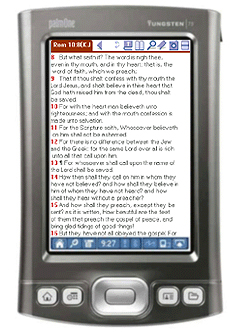
Screenshot of Palm Bible+ running on Palm T5Over at my personal website, I threw open a thought about how I forgot about the experience aspect of Bible applications because of changes in how I engaged the content. Here’s a snippet:

It used to be the case with Bible apps that I was very tied to the user experience within the application. But, I that changed a bit as I got involved with the Katana project. Yes, there is/was a need for getting a solid and usable experience for Bibles on the Maemo platform, but it wasn’t a pressing need for me. In fact, I wanted that project more because of the needs a visitor to MMM had more than my own. By the time the application got to a testing state, I was already steering away from the collection of Bibles that I owned, the application(s) that accessed them, and spent more time in-between the text pasting snippets of Scripture to notes and linking comments to pages and commentary online.

Read the rest of Failing to Remember the Bible App Experience.

Many of you have talked about the juggling of Bible software platforms because of different content offerings. Because of that juggling (of applications or libraries), does the software platform matter more or less than the content and what you can do with it?

When Mobile Becomes Virtually Real

Having finished reading You Are Not A Gadget, I am sitting in this space between imagination and reality. In a lot of respects, I am back near that place I was when MMM started, I am thinking about this question of mobile and whether the religious community is ready or equipped to answer it.

What is that question? It is a simple but profound: what happens when our tools become appendages then become doorways of experiencing faith in ways that are virtually real, but altogether a different lens than anything before it?

Dangerous question isn’t it? I am literally asking if we understand mobile and all other digital contexts not as they can become a part of our faith language, but that they develop interpretations and experiences of faith that have no grounding in what is understood now as “faith practices.”

Am I proposing that mobile, and later personalized virtual computing (augmented and virtual reality), will derive experiences that will be considered “living out/by faith” even as they have nothing in common with current faith practices outside of a shared history and end-expression*? Yup. And this scares the mess out of folks.

Take mobile. In every interview that I have done for mobile ministry, the question has come up if I can see there being a time when some aspect of mobile tech will take away the treasured face-to-face interactions. I always am careful to ground the answer in context – it depends on the environment and the faith practice/behavior that needs to be exercised. The answer isn’t will it, but rather in what contexts will it. Looking at it that way is exciting and scary… and it is this that we have to address.

Is your faith so grounded to a specific context that you can’t live outside of it? Or, is the way you would like to live out your faith so undefinable by the dominant digital faith contexts that you know that you feel and act out of a limited and unfulfilling spirit? Or, maybe this tweet better fits, “A friend calls mobile the “appendage,” does your church/ministry have a gym for that appendage or is it relegated to a diff zoning ordinance?”

For many people, there is little to no difference between online and offline expressions of faith. Does the description of your faith end where virtual reality begins, or can you confidently walk through the door of mobile/augmented reality/virtual reality and translate the beauty and immense glory of God into something unique yet altogether familiar? Expressions change, faith keeps a consistent and definable fingerprint.

*One can, and many do argue that if the apostles were to be ported to today’s time period that they would have a very hard time identifying a Christian inside the context of a church service, but would more readily see Christ-following in “secular” functions such as the United Way, Red Cross, etc.?